Multi-Entity Consolidations in QuickBooks: CFO Playbook
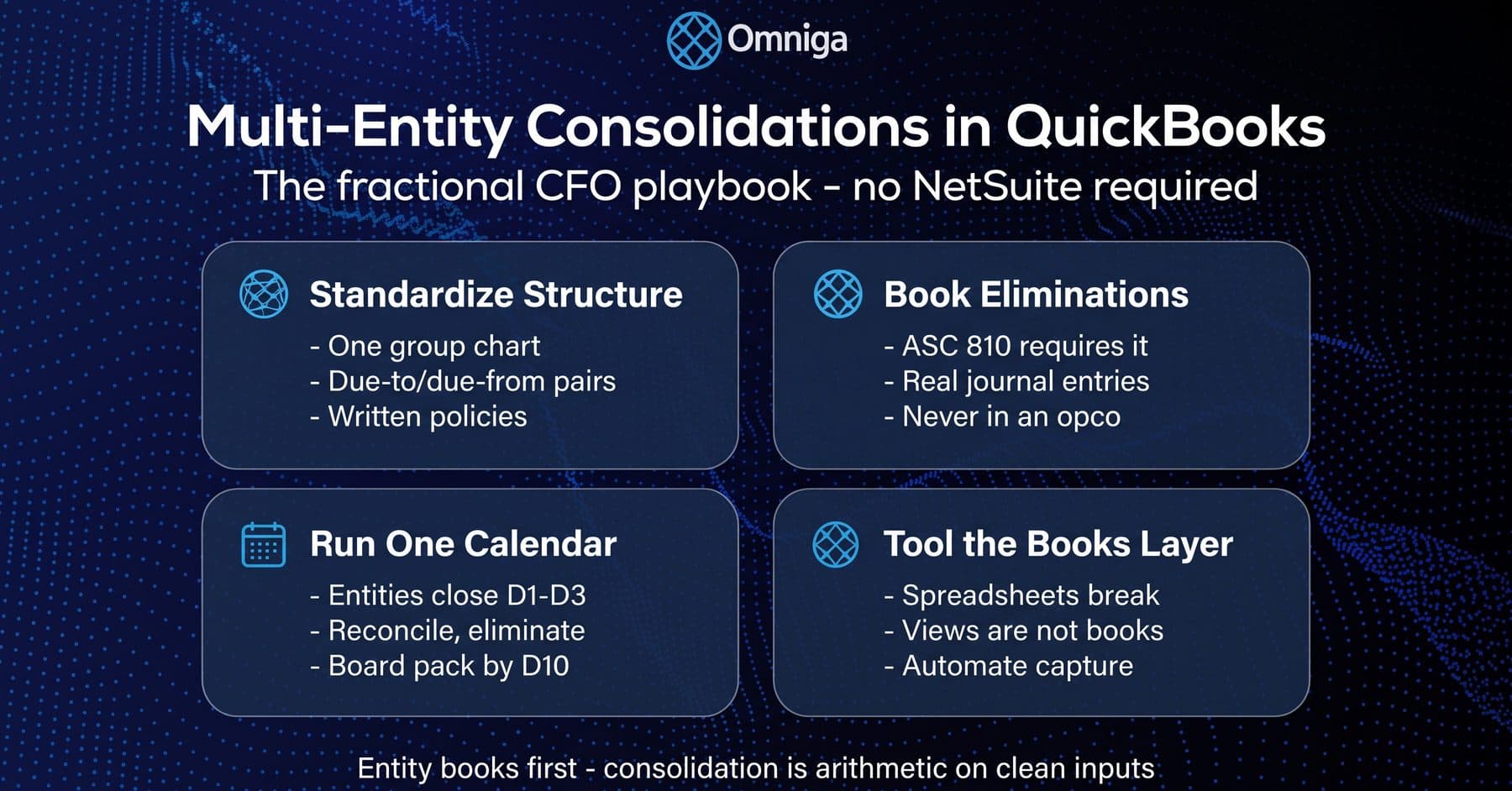
The fractional CFO playbook for multi entity consolidations in QuickBooks: intercompany structure, elimination entries, close cadence, and tooling.
Table of Contents
Part of our fractional CFO services guide.
Multi entity consolidations in QuickBooks combine the financials of two or more QuickBooks Online company files into one consolidated set of statements for the group — mapping every entity to a common chart of accounts, reconciling intercompany balances, and eliminating intercompany transactions so the group reports only its business with the outside world.
Best for: fractional CFOs running multi-entity clients on QuickBooks Online — holdco/opco groups, multi-brand ecommerce, franchises, real estate SPEs with 2–10 entities — and the operators who employ them. Not for: groups with daily intercompany trading, many functional currencies, or an audit posture that genuinely requires an ERP consolidation engine today. Do this next: if the real question is whether your client should leave QuickBooks entirely, start with the QuickBooks vs NetSuite decision guide. This playbook is for everyone staying.
Multi-Entity Consolidations in QuickBooks: The Four Real Options
Multi-entity clients are a fractional CFO's hardest and best clients at once. Hardest, because every entity multiplies the mechanical work: more files to close, more intercompany balances to chase, more consolidation hours the client experiences as "waiting for the numbers." Best, because a group that needs consolidated statements monthly is exactly the client that values senior finance leadership — and pays retainers that reflect it. The difference between those outcomes is whether your multi entity consolidations in QuickBooks run on a documented, repeatable system or on heroics.
The structural reality underneath: each legal entity lives in its own QuickBooks Online company file, and no QBO tier consolidates across files natively.
Key data: Intuit counts roughly 10 million small and mid-market business customers against a 49 million total addressable market, with US QuickBooks Online customers growing 8% in FY25 (Intuit Investor Day FY2026). The multi-entity groups in your portfolio are statistically on QBO — and will stay there until something forces a move.
So the group level has to be solved on top. There are four real ways to do it:
| Approach | What you get | Where it breaks | Cost shape |
|---|---|---|---|
| Native Intuit features (QBO Advanced Spreadsheet Sync; Intuit Enterprise Suite) | Multi-file data pulled into Excel or Sheets; IES adds intercompany eliminations | Spreadsheet Sync posts no eliminations; IES is a priced-up migration of its own, sold per quote | Per-file subscriptions; IES custom pricing |
| Spreadsheet consolidation | Full control, no new software | 86% of audited spreadsheets contained errors; version drift; the workbook becomes a shadow ledger | "Free," paid for in CFO hours every month |
| Reporting layer (LiveFlow, Fathom, Joiin) | Fast consolidated views across files | Adjustments are top-side, not ledger entries; books-layer problems pass straight through | Per-company subscriptions, low hundreds monthly |
| Books-layer automation + process (this playbook) | Consolidation-ready entity books, real elimination entries, one close calendar | Requires the structure and cadence in Steps 1–3 — discipline, not licenses | Subscription far below any ERP project |
This article is the fourth row: a practice playbook you can standardize across every multi-entity client. The economics work because clean entity books are the input to everything — AI bookkeeping automation for QuickBooks keeps each file consolidation-ready as transactions land. The hours you stop spending on mechanical roll-ups are margin; how that margin prices into retainers is covered in our fractional CFO cost guide.
Step 1 — Standardize the Intercompany Structure
Consolidation quality is decided before a single number moves. Every multi-entity engagement should start by imposing the same three standards, whatever the client's industry.
One group chart of accounts. Every entity file maps to a single group chart: same account names, same numbering, same rollup logic. "Software expense" must mean the same thing in the holdco and both opcos, or every close begins with a mapping exercise that belongs in setup.
Due-to/due-from pairs for every entity pair. Create a dedicated due-to and due-from account for each counterpart entity — not one mushy "intercompany" account. When the holdco pays an opco's payroll, the entry books to Due from Opco A in the holdco and Due to Holdco in Opco A, same amount, same period. Pairs make tie-outs mechanical: every due-from has exactly one mirror.
Written intercompany policies. Management fees, shared payroll splits, cost allocations, and transfer pricing all need a documented basis before the first invoice, not after the first audit question. For commonly controlled entities, the IRS applies the arm's-length standard of Section 482's related-party rules — intercompany charges should carry pricing a third party would have accepted.
This structure conversation is senior work, squarely inside what a fractional CFO does — and it is the step vendors skip when they pitch a tool as the fix. Having run intercompany books inside $20M–$1B groups before founding Omniga, I can report the failure mode is almost never the elimination math: it is one-sided capture. The holdco books the management fee; the opco never records its side; the mismatch surfaces weeks later in a consolidation that won't tie. Standardized pairs and policies kill that failure at the source — and they make multi-entity consolidations in QuickBooks repeatable across a client portfolio instead of bespoke per group.
Step 2 — Elimination Entries in QuickBooks Online
Eliminations are the step that turns stacked reports into true multi entity consolidations in QuickBooks: everything the group did with itself comes out. This is not a style preference:
Key data: Under ASC 810, intercompany balances and transactions are eliminated in consolidation — including open account balances, sales and purchases, interest, and dividends (PwC Viewpoint, ASC 810 intercompany guidance). A group that sells to itself has not earned revenue, and GAAP treats it that way.
QuickBooks Online will not post these for you, so elimination entries in QuickBooks Online workflows live in one of two places: a dedicated elimination "entity" (a separate company file holding only elimination journals) or the consolidation layer itself. Either works. What never works is burying eliminations inside an operating entity's books.
The standard SMB elimination set is short. Two worked examples cover most months (figures illustrative):
Management fee. Holdco charges Opco A a $10,000 monthly management fee. Entity books carry both sides; the consolidation layer reverses them:
| Entry | Account | Debit | Credit |
|---|---|---|---|
| Holdco (entity books) | Due from Opco A | $10,000 | |
| Management fee income | $10,000 | ||
| Opco A (entity books) | Management fee expense | $10,000 | |
| Due to Holdco | $10,000 | ||
| Elimination (consolidation layer) | Management fee income | $10,000 | |
| Management fee expense | $10,000 | ||
| Elimination (consolidation layer) | Due to Holdco | $10,000 | |
| Due from Opco A | $10,000 |
Intercompany inventory sale. Brand A sells inventory costing $8,000 to Brand B for $10,000; Brand B has not resold it at close. The group has moved goods between warehouses, nothing more — so revenue, cost, and the $2,000 of profit sitting in Brand B's inventory all come out:
| Entry | Account | Debit | Credit |
|---|---|---|---|
| Elimination (consolidation layer) | Intercompany revenue | $10,000 | |
| Intercompany COGS | $8,000 | ||
| Inventory (unrealized profit) | $2,000 |
Book eliminations as recurring, dated journal entries that reverse and re-post each period — visible, auditable, reviewable. Spreadsheet-only adjustments that live in a cell are how consolidations fail diligence.
Related reading: fractional controller services — the close-and-controls layer that owns these journals day to day.
Step 3 — The Close Cadence That Makes Multi-Entity Consolidations in QuickBooks Repeatable
Entity close first, consolidation second — always. Consolidating unfinished entity books means consolidating twice. The dependency chain becomes a calendar you can run identically across every multi-entity client:
| Business day | Work | Owner |
|---|---|---|
| D1–D3 | Entity-level closes: bank and card reconciliations, accruals, payroll posting in every file | Bookkeeping layer (automated capture + review) |
| D4 | Intercompany reconciliation: every due-to ties to its due-from; differences resolved in entity books | Controller / CFO |
| D5 | Elimination entries posted in the consolidation layer | Controller / CFO |
| D6–D8 | Consolidated statements drafted, reviewed, tied back to entity trial balances | CFO |
| D9–D10 | Consolidated board package delivered with commentary | CFO |
The non-negotiable is D4 before D5: intercompany balances reconcile before eliminations post, because eliminating an unreconciled balance hides the error instead of fixing it. Row ownership is the classic CFO vs controller split — the controller ties the books out, the CFO signs the group view.
This calendar is also your benchmark defense. Close speed is a known industry problem:
Key benchmark: 50% of finance teams take six or more business days to close, and 50% name Excel-driven processes as a key reason the close is slow, per Ledge's 2025 survey of 100 finance professionals reported by CFO.com. A multi-entity group on a standardized QBO cadence can land its consolidated package inside the window most single-entity teams need for one set of books.
The D9–D10 deliverable is where the engagement earns its retainer: a consolidated package built for decisions, not just compliance — the discipline covered in our management reporting QuickBooks guide.
Step 4 — Tooling: What Sits on Top of QuickBooks
Tooling comes last because tools amplify the process they are given. Three layers, honestly assessed:
Spreadsheets are fine for a two-entity group with minimal intercompany activity — and a documented liability beyond that. The most recent field audits of real organizational spreadsheets found errors in at least 86% of the spreadsheets audited (Panko, Spreadsheet Errors: What We Know, 2000), and a consolidation workbook — cross-tab links, manual elimination rows, month-over-month copy-paste — is precisely that high-risk artifact.
Reporting layers — LiveFlow, Fathom, Joiin — connect multiple QBO files and produce consolidated views quickly. They are genuinely useful for management reporting, and architecturally incapable of fixing the books: their eliminations are top-side report adjustments, not ledger entries. If the underlying files don't tie, you get a clean report built on a mismatch. Our consolidated financial reporting software explainer covers how this layer works, and the multi entity accounting software guide compares the options. Intuit's own ladder runs the same direction: QBO Advanced's Spreadsheet Sync pulls multiple files into a spreadsheet without eliminations, and Intuit Enterprise Suite adds elimination handling — as a quote-priced migration that is itself a mini ERP decision.
The books layer is where this playbook lives, and where automation compounds: transactions classified as they land in every entity file, intercompany items posted to the right due-to/due-from pairs on both sides, mismatches surfaced continuously instead of at D4. Omniga's approach is exception-first — auto-post what's confident, route the rest to human review — so entity books arrive at close consolidation-ready. Your consolidation layer then does arithmetic on clean inputs instead of forensics on dirty ones. That division of labor is what makes QuickBooks consolidation scale across a portfolio.
When a Client Actually Does Need to Leave QuickBooks
"No NetSuite required" is this playbook's default, not a religion. A minority of groups genuinely need an ERP consolidation engine. The honest thresholds:
- Entity count and churn: 10+ entities, or new entities forming quarterly.
- Intercompany volume: daily intercompany trading between entities, not periodic fees and allocations.
- Currencies: several functional currencies needing ledger-level translation, not reporting-layer conversion.
- Revenue complexity: in-ledger revenue recognition, project accounting, or manufacturing costing.
- Audit posture: recurring GAAP audits demanding system-enforced consolidation controls.
Two or more of those and the migration conversation is legitimate. What a fractional CFO owes the client is the real price tag of that conversation:
Key benchmark: Panorama Consulting's 2025 ERP Report puts the median ERP project at $450,000 — against respondents whose median revenue was hundreds of millions — and its 2026 report puts the median timeline at 9 months, with more than a quarter of projects over budget. For a $5M–$50M group, the same project is proportionally a far larger bet.
ERP is "later, not never" for clients trending toward those thresholds. Until then, multi entity consolidations in QuickBooks deliver statements the client can hand a lender — without the re-platforming project. The full stage-based migration framework is in the QuickBooks vs NetSuite guide linked at the top.
Frequently Asked Questions
Can QuickBooks Online consolidate multiple companies natively?
No. Every QuickBooks Online company file is a separate subscription with separate books, and no QBO tier posts cross-file consolidations with eliminations. QBO Advanced's Spreadsheet Sync pulls multiple company files into Excel or Google Sheets without eliminating intercompany activity; Intuit Enterprise Suite, a separate quote-priced product, adds elimination handling. Groups on standard QBO consolidate through a consolidation layer, a reporting tool, or a spreadsheet, booking elimination entries explicitly.
How do you record elimination entries in QuickBooks?
Elimination entries are booked outside the operating entities' books — in a dedicated elimination company file or in the consolidation layer — never inside an opco. Each entry reverses intercompany activity: management fee income against fee expense, due-to against due-from, intercompany revenue against intercompany COGS and any unrealized inventory profit. Book them as recurring, dated journal entries; that audit trail is what separates multi entity consolidations in QuickBooks from spreadsheet adjustments no one can trace.
What is a due-to/due-from account?
A due-to/due-from pair is a matched set of intercompany accounts: the entity owed money carries a due-from (an asset), and the entity that owes carries a due-to (a liability) for the same amount. Best practice is one dedicated pair per counterpart entity, so every intercompany balance has exactly one mirror. At consolidation, each due-to nets against its matching due-from and the pair eliminates to zero.
How long should a multi-entity close take on QuickBooks Online?
A disciplined multi-entity group on QuickBooks Online should deliver consolidated statements in six to eight business days, with the board package by day ten: entity closes on days 1–3, intercompany reconciliation on day 4, eliminations on day 5, consolidated statements on days 6–8. Half of finance teams take six or more business days to close a single set of books, per Ledge's 2025 benchmark survey — a consolidated close inside that window is a strong, achievable standard.
Do fractional CFOs need NetSuite to serve multi-entity clients?
No. A fractional CFO can run multi entity consolidations in QuickBooks for groups of roughly 2–10 entities using a common chart of accounts, due-to/due-from pairs per entity, explicit elimination entries, and a standardized close calendar — with automation keeping each entity file consolidation-ready. An ERP like NetSuite becomes the right answer at genuine thresholds: 10+ entities, daily intercompany trading, several functional currencies, or audit-driven systems requirements.
The Bottom Line
Multi entity consolidations in QuickBooks are a process problem before they are a software problem. Standardize the intercompany structure, book real elimination entries, run one close calendar, and add tooling that works at the books layer rather than papering over it. That system turns multi-entity clients from your hardest engagements into your most leveraged ones — and keeps NetSuite where it belongs, as a threshold decision instead of a default. If you want the entity-level books handled so your consolidation layer starts clean, see how Omniga works. More in this series: see all fractional solutions guides.