Multi-Entity Accounting Software for QuickBooks: A Guide
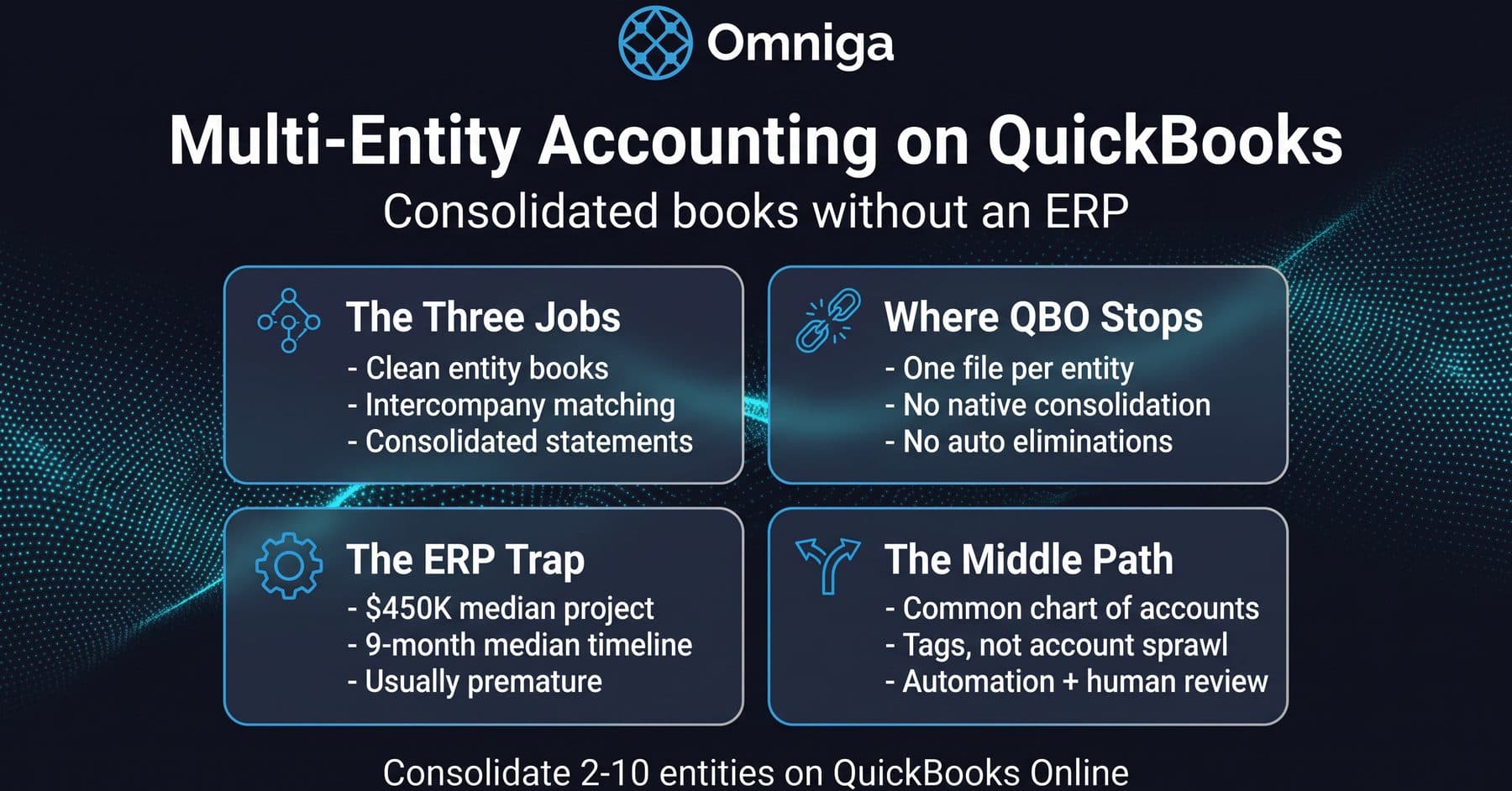
The practical guide to multi entity accounting software for QuickBooks operators: consolidation without an ERP, eliminations, and a decision matrix.
Table of Contents
Part of our bookkeeping services guide.
Multi entity accounting software maintains separate books for each legal entity in a group while producing consolidated financial statements for the whole. It combines entity-level ledgers, matches and eliminates intercompany balances, and reports the group as a single economic unit — without forcing every entity onto an ERP.
Best for: founders, operators, and finance leads running 2–10 legal entities on (or near) QuickBooks Online — holdcos, multi-brand groups, franchises, real estate SPEs, agencies with subsidiaries — who need a consolidated P&L and balance sheet without a six-figure platform migration. Not for: single-entity businesses, or groups already committed to public-company reporting, multi-ERP subsidiaries, and audit requirements that genuinely demand an ERP today. Do this next: if you're weighing whether to leave QuickBooks entirely, start with our QuickBooks vs NetSuite decision guide — this article covers the middle path most operators skip.
What Multi-Entity Accounting Software Actually Does
The category is easiest to understand as three jobs stacked on top of each other: keep clean books per legal entity, capture and match every transaction that crosses entity lines, and roll everything up into consolidated statements with the internal activity removed. Most tools marketed for "multi-entity" do only the first or last job well. The middle one — intercompany — is where groups actually bleed time, and it's the job this guide spends the most space on. I spent a career running intercompany books at $20M–$1B companies before founding Omniga, and the failure mode is always the same: the entity books look fine in isolation, and the group view doesn't tie.
Separate legal books, one consolidated view
Each legal entity in your group is a separate taxpayer. The IRS's Form SS-4 instructions are blunt about it: each corporation in an affiliated group must have its own EIN — its own tax identity, its own filings, and therefore its own books. That's the legal floor. The business need sits one level up: a lender, board, or acquirer doesn't want five P&Ls stapled together; they want one consolidated view of the group with the internal noise stripped out. Multi entity accounting software exists to satisfy both at once — entity books that stand on their own, and a group view built from them.
Intercompany transactions — and why they must eliminate
The moment money or goods move between your entities, you've created intercompany activity: the holdco pays payroll for an opco, one brand sells inventory to another, a management fee moves cash quarterly. In consolidated statements, that activity has to disappear — under ASC 810, intra-entity balances and transactions shall be eliminated, including open account balances, sales and purchases, interest, and dividends. This is a GAAP requirement, not a stylistic preference: a group that sells to itself hasn't earned revenue, and a due-to that never meets its due-from means someone's balance sheet is wrong. Elimination entries are the mechanism, and unmatched intercompany balances are the single most common reason a consolidation won't tie.
Common structures: holdco/opco, brands, franchises, SPEs
The same mechanics show up in predictable shapes. A holdco/opco structure concentrates shared costs (payroll, rent, software) at the top and pushes management fees down. Multi-brand ecommerce groups move inventory between entities at cost or transfer price. Franchise groups collect royalties from entity-level stores. Real estate groups run each property as an SPE with intercompany loans to the parent. The structure determines which eliminations dominate — management fees, intercompany inventory profit, royalties, or due-to/due-from loans — but every one of them needs the same three-job stack.
Can QuickBooks Online Handle Multiple Entities?
Honest answer: QuickBooks Online handles multiple entities as separate books, and stops there. Each entity lives in its own company file with its own subscription; the files share nothing at the ledger level, and there is no native cross-file consolidation on any QBO tier, including Advanced. What QBO does give you is the dominant, cheap, accountant-friendly ledger for each entity — bank feeds, reconciliation workflows, and an ecosystem your bookkeeper and CPA already know.
That installed-base reality is why the multi-entity question almost always starts from QuickBooks rather than from a blank slate.
Key data: Intuit's platform serves roughly 10 million small and mid-market businesses out of an estimated 49 million addressable, with US QuickBooks Online customers still growing 8% year over year (Intuit Investor Day FY2026). When a group forms a second or fifth entity, the ledger it reaches for is usually another QBO file.
Where it breaks is the group level. No native consolidation means no automated eliminations, no group chart-of-accounts mapping, no consolidated statements — and no warning when Entity A's due-from doesn't match Entity B's due-to. Every group solves that gap with tooling, process, or people. The next section covers the usual attempts.
The Usual Workarounds — and Where They Fail
Most groups on QBO evolve through the same three workarounds. Each solves the visible symptom and leaves the underlying gap.
| Workaround | What it solves | Where it fails | Layer |
|---|---|---|---|
| Excel consolidation template | A consolidated statement, eventually | Version drift, formula risk, manual eliminations, one person owns it | Reporting (manual) |
| Reporting add-ons (LiveFlow, Fathom, Joiin) | Fast multi-file roll-up views | Books-layer problems pass through; eliminations are top-side adjustments, not ledger entries | Reporting (automated) |
| ERP migration (NetSuite, Sage Intacct) | Real consolidation engine | Cost, 6–12 month timelines, retraining, and complexity most groups don't need yet | Books + reporting |
Excel consolidation templates
The spreadsheet consolidation is where everyone starts, and the research on where it ends is unambiguous.
Key finding: Across fifteen years of field audits of real organizational spreadsheets, errors were found in at least 86% of the spreadsheets audited (Panko, Spreadsheet Errors: What We Know, 2008). The research is not new and it has not been overturned — and a consolidation workbook, with links across entity tabs, manual elimination rows and month-over-month copy-paste, is exactly the high-formula-count artifact those audits describe.
The deeper problem isn't any single error; it's that the workbook is a shadow ledger. Eliminations live in cells instead of journal entries, the logic lives in one person's head, and every month-end starts with "is this the current version?"
Reporting add-ons: a layer, not a ledger
Tools like LiveFlow, Fathom, and Joiin connect multiple QBO files and produce consolidated views quickly — genuinely useful for management reporting. The limitation is architectural: they sit above the books. If intercompany balances don't tie in the underlying files, the add-on either shows the mismatch or papers over it with a top-side adjustment that exists only in the reporting tool. You get a consolidated report; you don't get consolidated books. For boards and internal decisions that's often enough. For lenders, audits, and diligence, the adjustments need to trace to the ledger.
Jumping straight to an ERP
The third path is the one every vendor on page one of the search results recommends: migrate the whole group to NetSuite or Sage Intacct. Sometimes that's right — the decision matrix below is honest about when. But it's a platform migration sold as a reporting fix, and it deserves the scrutiny of the next section.
Why ERP Migration Is Usually Premature
ERP consolidation engines are excellent. The question is not whether NetSuite consolidates better than QuickBooks — it does — but whether this group, at this size should buy a re-platforming project to fix what is usually a process-and-tooling gap.
The true cost of migrating
The sticker price is licenses; the real price is the project. Independent research on ERP implementations puts numbers on it:
Key benchmark: Panorama Consulting's 2025 ERP Report puts the median ERP project at $450,000, drawn from 172 respondents whose median annual revenue was $400.5 million. Its 2026 report puts the median duration at 9 months, with more than a quarter of organizations over budget and almost a quarter over schedule. Read the cost against the revenue base it came from: for a $5M–$50M group, the same project is proportionally an order of magnitude larger bet.
Add what the surveys can't price: 6–12 months of your finance lead's attention, retraining everyone who touches the ledger, rebuilding every bank feed and integration, and the audit-trail break at cutover. For context, a done-for-you bookkeeping stack on QBO — including multi-entity work — runs orders of magnitude below that; see our bookkeeping services pricing guide for real package numbers, or our pricing for operators for what the automated stack itself costs.
The stay-or-migrate decision matrix
Score your group honestly. "Stay" means QBO entity files plus automation and a dimensional structure; "migrate" means a genuine ERP requirement is present.
| Signal | Stay on QBO + tooling | ERP is genuinely warranted |
|---|---|---|
| Entity count | 2–10 files | 10+ entities, or frequent entity creation |
| Intercompany volume | Periodic (payroll splits, management fees, occasional transfers) | Daily intercompany trading between entities |
| Currencies | 1–2, translation at reporting layer acceptable | Many functional currencies needing ledger-level translation |
| Revenue complexity | Standard invoicing/ecommerce/SaaS billing via integrations | Complex rev rec, project accounting, or manufacturing costing in-ledger |
| Audit requirements | Reviewed or internally-prepared statements | Recurring GAAP audits demanding system-enforced controls and consolidation |
| Finance team | Fractional/lean team | Dedicated controller-plus team able to own an ERP |
Two or more checks in the right column and the migration conversation is real — do the capability comparison before talking to vendors. Zero or one, and you're about to spend $450,000 to avoid fixing your chart of accounts.
Related reading: quickbooks vs netsuite — the stage-based framework for the full migration decision.
How Automation Plus Dimensional Structure Consolidates on QBO
The middle path — the one the listicles skip — is to keep QBO as the entity-level ledger and add two things: a deliberate structure that makes the files consolidation-ready, and automation that does the intercompany and close work software should do. This is financial consolidation in QuickBooks done at the books layer, not pasted on top, and it is what most multi entity accounting software should actually be judged on.
Design a common chart of accounts across entities
Consolidation quality is decided at setup. Every entity file maps to one group chart of accounts: same account names, same numbering, same rollup logic, so "Software expense" means the same thing in every file. The payoff shows up directly in close speed: APQC's open-standards benchmark for cycle time to complete monthly consolidated financial statements puts the median at 6.0 days across a sample of more than 11,000 companies — and the groups that hit it are the ones where every entity file already rolls up to the same account structure, with no mapping exercise standing between trial balance and consolidation.
Use dimensions and tags instead of account sprawl
The instinct to encode entities, brands, and locations as extra accounts is how charts of accounts bloat into unmanageability. Keep the account list short and push that meaning into dimensions — classes, locations, and tags in QBO. If you want the full architecture, our chart of accounts alternative guide lays out the tag-based model; the multi-entity payoff is that a lean, common account structure plus dimensions gives you group reporting cuts (by entity, by brand, by location) without 400-line account lists diverging per file.
Automate intercompany capture and matching
Intercompany discipline fails at capture, not at month-end: the holdco pays an opco bill in March, nobody books the due-from, and the mismatch surfaces in April's consolidation. Automation fixes the capture step — transactions hitting entity books are classified as they land, intercompany-tagged items post to due-to/due-from pairs on both sides, and unmatched balances surface continuously instead of at close. This is the core of what AI bookkeeping software does for a multi-entity group: the volume work is automated, the judgment calls go to a human. That is the whole design principle — auto-post what the system is confident about, route everything else to a review queue, and never let an unreviewed intercompany entry reach a consolidated statement.
Book the eliminations: due-to/due-from, revenue, fees
The standard elimination set for an SMB group is short and repeatable:
- Due-to/due-from netting — every intercompany payable nets against its matching receivable; residuals are reconciling items to chase, not to plug.
- Intercompany revenue and COGS — sales between entities reverse at the group level, including profit sitting in unsold intercompany inventory.
- Management fees and shared-cost allocations — the holdco's fee income reverses against each opco's fee expense.
- Intercompany interest and dividends — reverse both sides, per the ASC 810 list above.
Book them as recurring journal entries in a consolidation file or tool — visible, auditable, reversible — never as spreadsheet-only adjustments.
Run the consolidated close as one calendar
A multi-entity close is a dependency chain: entity books finish, intercompany matches, eliminations post, group statements issue. Sequence it as one calendar — bank and credit card reconciliations per entity first (our QuickBooks reconciliation services guide covers that layer's quality standard), intercompany matching by day 3, eliminations by day 5, consolidated statements by day 6–8. For calibration, APQC measures exactly this span — initial monthly trial balance to completed consolidated statements — and puts the median at 6.0 days; a multi-entity group running clean automation should treat that as a target it can meet, not a stretch goal.
Related reading: quickbooks reconciliation services — the entity-level reconciliation standard the group close depends on.
Choosing Multi-Entity Accounting Software: A 10-Point Checklist
First, know which layer you're buying
Every option in this market is a books layer (owns ledger entries and eliminations), a reporting layer (reads ledgers, produces views), or an ERP (replaces the ledgers). Most bad purchases are layer mismatches — buying a reporting tool and expecting it to fix intercompany, or buying an ERP to fix a chart of accounts.
The checklist
- Ledger-level eliminations — are eliminations journal entries somewhere auditable, or top-side report adjustments?
- Intercompany capture — does it create/match due-to/due-from pairs as transactions land, or find mismatches at close?
- Group chart-of-accounts mapping — can entity accounts map to one group structure without renaming every file?
- QBO sync depth — two-way transaction-level sync, or a nightly summary pull?
- Multi-currency translation — at the level you actually need (reporting translation vs ledger-level)?
- Audit trail — can you trace every consolidated number to entity-level entries?
- Close workflow — checklists, sign-offs, and status across entities, or just reports?
- Human review — when automation is uncertain, does a person see it before it posts?
- Pricing shape — per-entity fees that punish growth, or group pricing?
- Exit path — if you do outgrow it into an ERP later, does your data leave cleanly?
If you'd rather buy the outcome than operate the tool, done-for-you virtual and outsourced bookkeeping increasingly covers multi-entity scope — and Omniga's approach is exactly the stack this article describes: automated capture and classification with human review across your QBO entity files, a common structure, and a consolidated close you can hand a lender. If that middle path sounds like your group, see how it works.
Related reading: outsourced bookkeeping vs in-house — the staffing side of the same decision.
Frequently Asked Questions
Can QuickBooks Online consolidate multiple companies?
No — QuickBooks Online has no native consolidation on any tier. Each company file is a separate subscription with separate books, and QBO will not combine files, match intercompany balances, or post eliminations. Groups on QBO consolidate through a consolidation tool or automation layer that maps the files to a common chart of accounts and books eliminations, through spreadsheets, or by migrating to an ERP.
What is the difference between multi entity accounting software and an ERP?
Multi entity accounting software keeps each entity's existing ledger (typically QuickBooks Online files) and adds the group layer on top: common account mapping, intercompany matching, elimination entries, and consolidated statements. An ERP replaces the ledgers themselves with one system that consolidates natively. The software path costs a monthly subscription and preserves your bookkeeping stack; the ERP path is a re-platforming project — a $450,000 median cost per Panorama Consulting's 2025 ERP research, and a 9-month median timeline per its 2026 report.
How do intercompany eliminations work?
Intercompany eliminations are journal entries that remove transactions between group entities from consolidated statements, as ASC 810 requires. The standard set: net every due-to against its matching due-from, reverse intercompany revenue against the buyer's expense or inventory (including profit in unsold intercompany stock), reverse management fees on both sides, and reverse intercompany interest and dividends. After eliminations, the consolidated statements show only transactions with outside parties.
How many entities can you realistically run on QuickBooks Online?
Roughly 2 to 10 entities is the practical range for QBO-based groups, with each entity in its own company file. The constraint isn't a file limit — it's operational: intercompany volume, close coordination, and currency complexity grow with each entity. With a common chart of accounts, automated intercompany capture, and a consolidation layer, groups at the upper end of that range run reliable monthly consolidated closes on QBO; past it, or with daily intercompany trading, ERP evaluation becomes rational.
How much does multi entity accounting software cost compared to NetSuite?
Multi-entity tooling on QuickBooks is subscription pricing — typically in the hundreds of dollars per month depending on entity count and scope — while an ERP like NetSuite is a project plus recurring licenses: Panorama Consulting's 2025 research puts the median ERP implementation at $450,000, with a 9-month median timeline in its 2026 report, before annual license costs. The honest comparison is total cost of change: the QBO path keeps your existing files, bank feeds, and accountant workflow; the ERP path replaces all three.
The Bottom Line
Multi entity accounting software is a solved problem on QuickBooks when you treat it as three jobs: clean entity books, disciplined intercompany, and a consolidation layer that books real eliminations. The spreadsheet fails on error rates, reporting add-ons fail at the books layer, and an ERP is the right answer for the minority of groups the decision matrix actually points there. For everyone else, a common chart of accounts, dimensions instead of account sprawl, and automated capture with human review deliver consolidated statements at SMB cost. More in this series: see all bookkeeping solutions guides.