Best Consolidation Software for QuickBooks (2026 Guide)
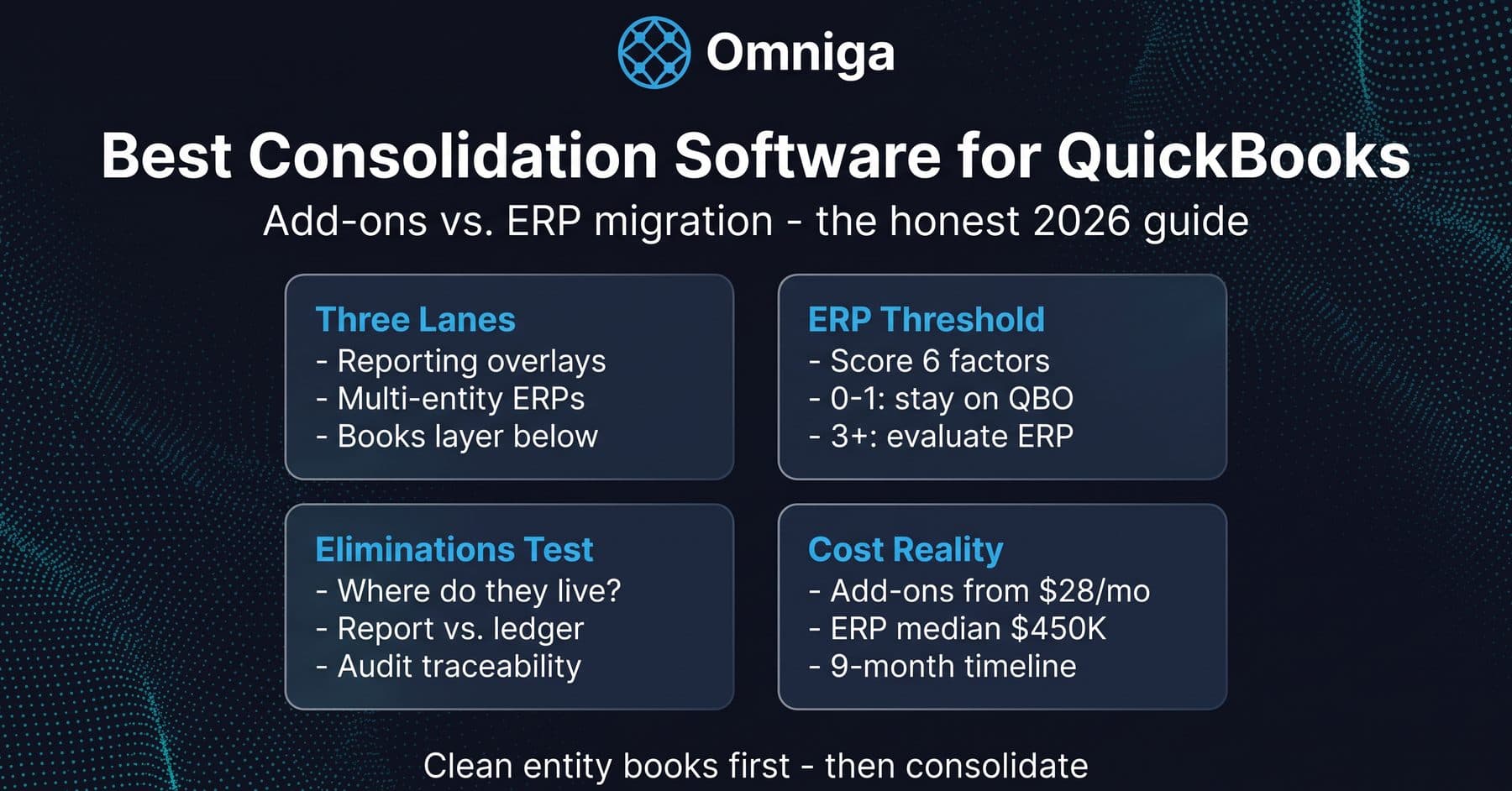
The best consolidation software for QuickBooks groups, compared honestly: add-ons vs. ERP migration, an eliminations litmus test, and verified pricing.
Table of Contents
Part of our finance automation tools guide.
The best consolidation software for a QuickBooks-based group combines multiple company files into one set of group financials — handling chart-of-accounts mapping, currency translation, and intercompany eliminations — without requiring a migration off QuickBooks. Below the ERP threshold, the right choice is a consolidation layer on top of clean entity books, not a new ledger.
Best for: operators and finance leads running 2–8 entities on QuickBooks Online — holdcos, multi-brand ecommerce, franchise and agency groups — shortlisting the best consolidation software without sitting through six ERP demos. Not for: single-entity businesses, or groups whose statutory multi-GAAP, audit, and operational requirements genuinely demand an ERP today. Do this next: if the real question is whether to leave QuickBooks entirely, start with our quickbooks vs netsuite decision guide — this roundup covers the layer you add if you stay.
The Best Consolidation Software for QuickBooks at a Glance
Every ranking page for this query is written by a vendor that ranks itself first. This one is too — Omniga appears in the table below, and we make it — so here is the honest version: tools grouped by what they actually are, a real "not for you if" list for Omniga, and every pricing note pulled from the vendor's own published page in October 2026. The best consolidation software question is really a lane question: reporting overlays and add-ons on top of your QBO files, multi-entity ERPs that replace QuickBooks, or the books layer underneath — automation that keeps each entity's ledger clean enough to consolidate at all.
| Tool | Lane | Native eliminations | COA mapping | Multi-currency | Entity scale | Published pricing (Oct 2026) |
|---|---|---|---|---|---|---|
| Fathom | Reporting overlay | Yes, in consolidated groups | Yes | Yes | Up to 300 entities | $450/mo incl. 25 companies, +$17/extra |
| LiveFlow FP&A | Consolidation add-on | Yes, one-click intercompany | Yes, intelligent mapping | 160+ currencies | Partial-ownership support | Quote-based |
| Joiin | Consolidation add-on | Yes, elimination groups | Yes | Pro/Max plans | Priced per company count | From $28/mo (1 co.); ~$111/mo (10) |
| Spotlight Reporting | Advisor reporting suite | Yes, in consolidations | Account groupings | Yes | 75 orgs (core); 500 (Multi) | Low-$300s/mo for 10 orgs |
| Syft Analytics | Reporting overlay (Xero-owned) | Yes | Yes | Yes | Unlimited claimed | Retired post-acquisition |
| Qvinci | Consolidation + BI | Manual entries with approval | Patented SCOA mapping | Conversion via Xe rates | Franchise-scale | Not published; quoted |
| Omniga (ours) | Books layer + consolidation | Yes, ledger-level | Yes, common group COA | Reporting-layer translation | Built for 2–10 QBO files | Published monthly pricing |
| NetSuite | ERP | Yes, native | N/A (one ledger) | Yes | Hundreds of subsidiaries | Annual license + implementation fee |
| Sage Intacct | ERP | Yes, auto-eliminations | N/A (one ledger) | Yes, ASC 830 CTA automation | Hundreds of entities | Quoted |
Signs You've Outgrown Single-Entity Reporting
QuickBooks Online is a per-entity ledger: each company is its own file and subscription, and no QBO tier consolidates across files. The moment a lender or board asks for one group view, operators discover the gap. The signals it's time for QuickBooks multi company consolidation tooling:
- Two or more QBO files with intercompany activity — management fees, shared payroll, inventory transfers, due-to/due-from loans.
- A monthly workbook someone "owns" — one person's spreadsheet as the group view is a single point of failure.
- Board or lender requests for consolidated statements — five stapled P&Ls with internal revenue still in them don't qualify.
- Close dates slipping as entities multiply.
Key data: Half of finance teams take six or more business days to close, and 50% name Excel-driven processes as a top blocker (Ledge month-end close benchmarks via CFO.com, 2025).
Still deciding how to structure the entity books themselves? Start with our multi entity accounting software guide — this roundup assumes the files exist and picks the group layer.
Consolidation Layer vs. ERP: The Two-Lane Decision
The expensive mistake isn't picking the wrong add-on — it's entering the wrong lane. Vendor roundups rarely say where consolidation software stops being enough, so operators overbuy an ERP early or stretch an overlay past its limits. Score your group before shortlisting the best consolidation software in either lane.
The ERP Threshold Scorecard
Score one point per row:
| Factor | 0 points | 1 point |
|---|---|---|
| Entity count | 2–8 QBO files | 10+ or constant entity creation |
| Intercompany volume | Periodic fees, transfers, loans | Daily intercompany trading |
| Currencies | 1–2, reporting-layer translation | Many functional currencies, ledger-level |
| Statutory requirements | Single GAAP, reviewed or internal | Multi-GAAP filings, recurring audits |
| Operational depth | Standard invoicing/ecommerce/SaaS | Manufacturing costing, complex rev rec |
| Finance team | Fractional or lean | Controller-plus team to own a platform |
0–1 points: stay on QuickBooks with a consolidation layer. 2 points: borderline — fix books and process, re-score in two quarters. 3+ points: evaluate an ERP seriously.
Why an ERP is overkill below the threshold
Below that line, migration buys a project, not a report:
Key benchmark: The median ERP implementation ran $450,000 in Panorama Consulting's 2025 ERP Report, and its 2026 report puts the median timeline at 9 months, with more than a quarter of organizations over budget.
Panorama's respondents had median revenue in the hundreds of millions; for a $5M–$50M group the same project is proportionally a far larger bet. The stack that works below the threshold: entity books kept clean by AI bookkeeping automation for QuickBooks, a consolidation layer that maps accounts and books eliminations, and group reporting on top — our consolidated financial reporting software explainer covers the process side of that layer.
Related reading: quickbooks vs netsuite — the stage-based framework for the full migration decision.
The QBO-Native Consolidation Add-Ons, Tool by Tool
The first lane: QuickBooks consolidation add-ons that connect to your company files and produce a group view. Every fact below comes from the vendor's own published pages, fetched October 2026 — names only, no affiliate links.
Fathom
A polished reporting overlay consolidating up to 300 entities across QuickBooks, Xero, MYOB, and Excel sources, with multi-currency consolidations and eliminations — $450/month including 25 companies (+$17 per extra), consolidated groups free. Best for presentation-quality board reporting across a portfolio. Not for ledger-level intercompany control — eliminations live in the consolidated view, not in any entity's books.
LiveFlow
LiveFlow now sells two products: Flow ERP, a multi-entity ERP that replaces QuickBooks as the ledger, and LiveFlow FP&A, the QBO-connected add-on covered here. LiveFlow FP&A is a spreadsheet-native consolidation layer (Google Sheets and Excel) with intelligent account mapping, one-click intercompany eliminations, 160+ currencies, and custom ownership percentages. Pricing is quote-based. Best for finance teams who live in spreadsheets and want live QBO data behind them. Not for buyers who want cost transparency before a demo, or groups evaluating Flow ERP, which belongs in the ERP lane below.
Joiin
The fastest to deploy and most transparently priced: from $28/month for one company, roughly $111/month for ten, with COA mapping and elimination groups on every plan and multi-currency on upper tiers. Eliminations apply at report time. Best for lower-complexity SME groups wanting quick, affordable consolidated reports. Not for groups needing eliminations in a ledger or a reconciliation step before the roll-up.
Spotlight Reporting
An advisor-oriented suite — reporting, forecasting, dashboards — consolidating up to 75 organizations in its core product (its franchise-focused Multi aggregates up to 500), with multi-currency and eliminations. Pricing tiers by organization count; published plans run low-$300s per month for ten organizations. Best for firms and franchise systems producing branded advisory packs. Not for operator-led groups outside an advisor workflow.
Syft Analytics
The asterisk in every stale roundup: Xero acquired Syft (announced September 2024). Syft continues standalone and still connects QuickBooks Online, Xero, and Sage, but its public pricing page is retired and its features are folding into Xero's embedded Analytics (renamed from "Analytics powered by Syft" in February 2026). Best for existing Syft users and Xero-centric stacks. Not for a new QBO-group purchase in 2026 — the roadmap now belongs to Xero.
Qvinci
A consolidation and BI platform with patented automated mapping of each location's chart of accounts to a standard COA, built for franchise systems on QuickBooks and Xero. Elimination entries are manual with approval; pricing is not published. Best for franchise-scale standardization and benchmarking. Not for small holdco groups needing simple self-serve consolidation.
The eliminations litmus test
Under ASC 810, intra-entity balances and transactions must be eliminated in consolidation — a group that sells to itself hasn't earned revenue. The most useful question for any vendor in this lane: where do my eliminations live?
| Tool | Eliminations approach | Trace back to a ledger? |
|---|---|---|
| Fathom | Applied in the consolidated group view | No — view-level |
| LiveFlow FP&A | One-click intercompany elimination in the consolidation | No — layer-level |
| Joiin | Elimination groups applied at report time | No — report-level |
| Spotlight Reporting | Eliminations within consolidations | No — report-level |
| Qvinci | Manual elimination entries with approval | Held in Qvinci; journal sync is an add-on |
| Omniga | Elimination entries booked at the books layer | Yes — auditable entries |
| NetSuite / Sage Intacct | Native, automated in-ledger | Yes — one system of record |
View-level eliminations suit management reporting; for lenders, audits, and diligence, adjustments living only in a reporting tool eventually get re-derived. For how these add-ons fit the broader stack, see our quickbooks integrations roundup.
The ERP Lane: NetSuite, Sage Intacct, Gravity
Past the scorecard threshold, the best consolidation software is an ERP's native engine: NetSuite automates intercompany reconciliation and close tasks across subsidiaries (annual license plus a one-time implementation fee), and Sage Intacct auto-generates eliminations and non-controlling interest with ASC 830-compliant currency translation. Gravity Software plays the same lane as a lighter multi-entity cloud ledger. LiveFlow's Flow ERP is a newer entrant in the same lane. You pay in money, months, and workflow agility — these are late-stage tools bought too early far more often than too late. Revisit the scorecard before any demo; treat the Panorama numbers as the base case.
Clean Entity Books First: The Lane Every Roundup Skips
The quiet part no vendor ranking says: even the best consolidation software faithfully consolidates whatever is in each QuickBooks file. Entity books carrying uncategorized transactions, unreconciled accounts, and mismatched due-to/due-from pairs produce confident-looking garbage at the group level — faster.
Key finding: Field audits of real operational spreadsheets found errors in at least 86% of spreadsheets examined (Panko, "Spreadsheet Errors: What We Know," 2008) — and the manual consolidation workbook is exactly the high-formula-count artifact those audits describe.
The fix starts below the reporting layer: per-entity bank reconciliation software discipline, clean accounts payable automation quickbooks workflows, and payout-level control for commerce entities (see our stripe reconciliation tools for quickbooks guide). Only then does the consolidation layer have something worth rolling up.
What I saw running intercompany books from $20M to $1B
Before founding Omniga, I ran multi-entity and intercompany books at companies from $20M to over $1B, and both failure modes of this market showed up on schedule. The Excel failure mode: an intercompany loan booked on different days by different bookkeepers until the due-to/due-from pair drifted six figures and nobody could say which side was right. The premature-ERP failure mode: a nine-month migration bought to fix a drifted chart of accounts and three months of unreconciled banks — the new system consolidated the same mess, natively. The groups that got it right fixed the books layer first, then bought the smallest tool that produced a defensible group view.
Where Omniga fits — and where it doesn't
Omniga is the third lane: bookkeeping automation for QuickBooks that keeps every entity file continuously categorized, reconciled, and close-ready, with multi-entity consolidation on top — a common group chart of accounts, intercompany capture as transactions land, and eliminations booked at the ledger level rather than patched into a report. It's a different purchase: the outcome rather than a tool you operate — closer to automated bookkeeping software with a human review layer than to a dashboard product.
Quiet AI™ Note: We optimize for exception-first accounting: auto-post what's confident, route the rest to review.
Honestly not for you if: you only need board reports over books you already trust (Fathom or Joiin is cheaper); you want a self-serve tool your team drives (we're a service plus software); your entities aren't on QuickBooks Online; or you scored 3+ on the threshold. In the 2–10 entity QBO lane with a books-layer problem, our pricing for operators is published next to the tools above — no demo required.
How to Choose the Best Consolidation Software: A 5-Step Shortlist
- Score the ERP threshold first. 3+ points means you're reading the wrong roundup — run a real ERP evaluation.
- Audit entity-book quality before any demo. Unreconciled accounts and intercompany mismatches disqualify every tool in lane one — fix the books layer first, or buy it fixed.
- Apply the eliminations litmus test. Where do eliminations live, who approves them, and do they trace to a ledger? One question, and it separates the field faster than any feature grid.
- Price at your entity count in two years. Per-company pricing diverges sharply between 5 and 20 entities; get written quotes from vendors that don't publish rates.
- Pilot with last month's actuals. If the trial can't reproduce your current workbook's numbers or explain the difference, walk.
Frequently Asked Questions
What is the best consolidation software for QuickBooks Online?
The best consolidation software for QuickBooks Online depends on your lane: Joiin and Fathom for affordable report-level consolidation across 2–10 QBO files, LiveFlow for spreadsheet-native consolidation with one-click eliminations, and Omniga as the books-layer option combining bookkeeping automation with ledger-level consolidation. Groups scoring 3+ on the ERP threshold should evaluate NetSuite or Sage Intacct instead.
Can QuickBooks Online consolidate multiple companies natively?
No. QuickBooks Online has no native consolidation on any tier, including Advanced — each company file is a separate subscription, and QBO will not map accounts, eliminate intercompany balances, or combine statements across files. Every QBO group consolidates through an add-on, a spreadsheet, a books-layer service, or an ERP migration.
Do QuickBooks consolidation add-ons handle intercompany eliminations?
Most handle them at the report level: Fathom, Joiin, Spotlight Reporting, and LiveFlow apply elimination rules inside the consolidated view — fine for management reporting, but nothing posts back to a ledger. Qvinci holds manual elimination entries with approval. For eliminations that trace to auditable ledger entries, the options are a books-layer service like Omniga or a full ERP.
When should a multi-entity business move from QuickBooks to an ERP?
Move when at least three of these are true: 10+ entities or constant entity creation, daily intercompany trading, many functional currencies, statutory multi-GAAP filings or recurring audits, and in-ledger operational complexity like manufacturing costing. Below that, the median $450,000 cost and 9-month timeline of an ERP implementation (Panorama Consulting, 2025 and 2026 reports) buys a re-platforming project, not better reporting.
How much does consolidation software for QuickBooks cost?
Published pricing in October 2026 ranges from $28/month (Joiin, one company; ~$111/month for ten) to $450/month including 25 companies (Fathom), with Spotlight Reporting in the low-$300s per month for ten organizations. LiveFlow and Qvinci quote by group; ERP-lane options are quoted annually plus an implementation project. The best consolidation software for your budget is priced at the entity count you'll reach in two years, not today's.
The Bottom Line
The best consolidation software decision is a lane decision. Score the ERP threshold first; below it, stay on QuickBooks and pick the group layer deliberately — overlays for polish, add-ons with real elimination handling for substance, the books layer underneath for numbers that survive a lender's questions. Apply the eliminations litmus test and pilot on last month's actuals before committing. More in this series: see all finance automation solutions guides.