Multi-Entity Bookkeeping: What Changes & How to Do It
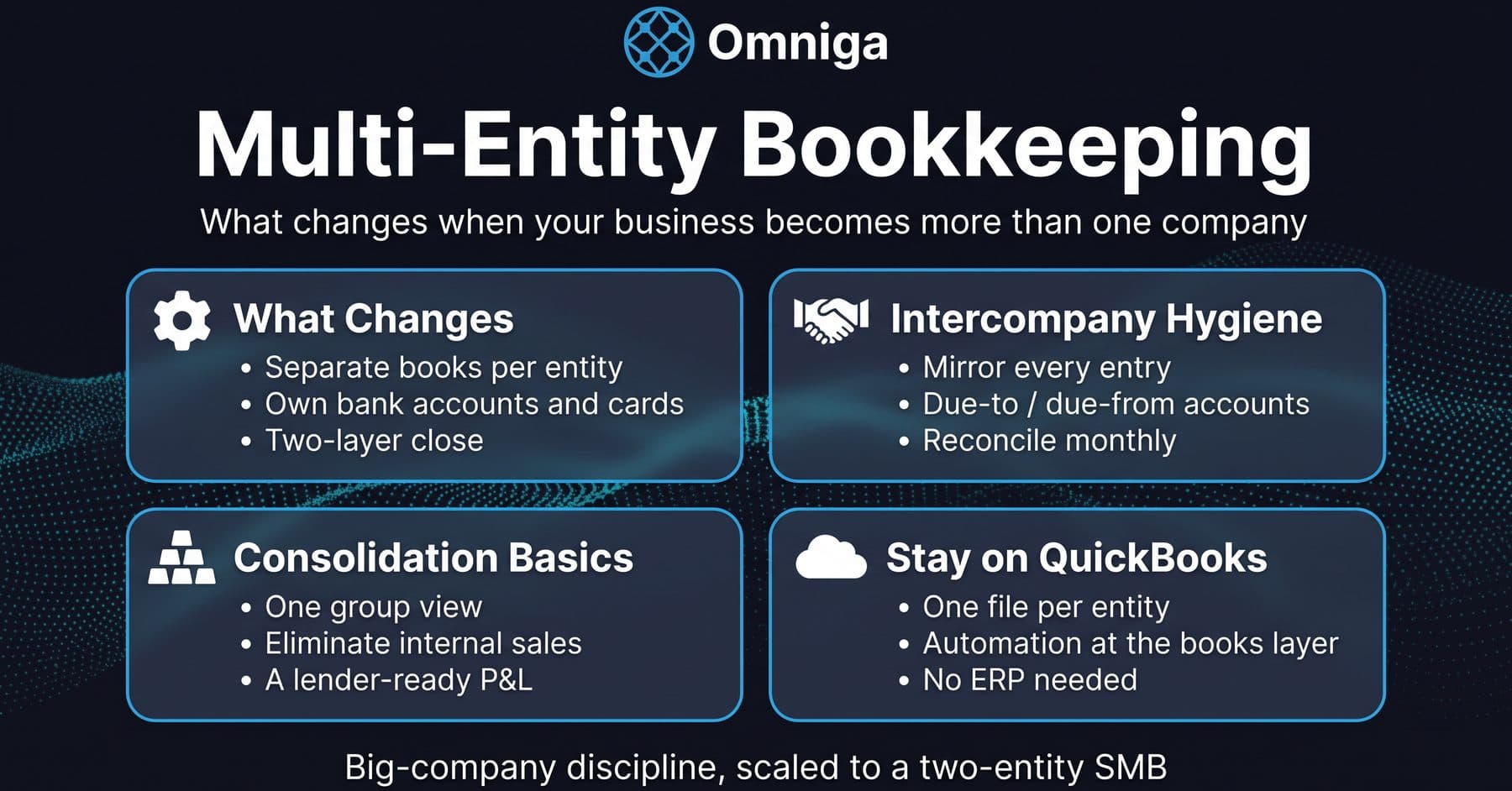
Multi entity bookkeeping explained for operators: separate books per LLC, intercompany hygiene rules, consolidation basics, and costs — no ERP required.
Table of Contents
Part of our bookkeeping services guides for operators.
Multi entity bookkeeping is the practice of keeping separate, complete books for each legal entity in a group while tracking every transaction that moves between them — so each entity can stand on its own for taxes and liability, and the group can still be read as one business. It is a set of disciplines, not a new platform.
Best for: founders and owner-operators at the moment of becoming multi-entity — a second LLC, a holding company, an acquisition, per-property real estate entities — typically $1M–$20M revenue, on QuickBooks Online. Not for: single-entity businesses, or large groups with daily intercompany trading and audit requirements that genuinely point to an ERP. Do this next: already shopping for tooling? Go straight to our multi entity accounting software guide — this article covers the habits that make any tool work.
You Just Became Multi-Entity — Here's What Actually Changed
The week the second entity is formed, most owners expect more paperwork at tax time and otherwise business as usual. In reality, multi entity bookkeeping changes the daily mechanics of how money is allowed to move:
| Area | One company | Two or more companies |
|---|---|---|
| Bank accounts | One set, one card stack | Separate accounts and cards per entity — no sharing |
| Books | One ledger | One complete ledger per entity, plus a group view |
| Moving money | "My money" — transfer freely | Every transfer is a recordable transaction between two parties |
| Shared expenses | Just book it | Needs a documented allocation method |
| Payroll & owner pay | One payroll | Each person paid by the entity they work for |
| Month-end close | One close | Two layers: each entity closes, then the group consolidates |
Why businesses add entities
The triggers are predictable: liability separation for a new line of business, a partner who owns a stake in one venture but not another, an acquisition, per-property real-estate LLCs, franchise growth. All are good reasons — and all turn "my books" into bookkeeping for multiple businesses on day one, planned or not.
The golden rule: every legal entity gets its own complete books
Each entity in your group is its own taxpayer. The IRS's Form SS-4 instructions are blunt: each corporation in an affiliated group must have its own EIN — its own tax identity, and therefore its own records. "We'll sort it out at year-end" is not a bookkeeping method; it's a cleanup project with interest.
Key data: The IRS requires each corporation in an affiliated group to have its own EIN (Form SS-4 instructions, reviewed April 2026), and its recordkeeping guidance (May 2026) expects records that "prepare your financial statements" and "support items reported on your tax returns" — per entity, not per owner.
The Five Multi-Entity Bookkeeping Changes That Hit Immediately
1. Separate bank accounts and cards per entity
Commingling funds is the classic first mistake, and it's worse than messy books: courts can set aside your liability protection when owners treat entities as one pocket. Cornell's Legal Information Institute lists intermingling of personal and corporate assets among the misconduct that justifies piercing the corporate veil — undoing the main legal reason you formed the entity. Separate accounts, separate cards, from day one. (Structure has legal and tax consequences; confirm yours with your CPA and attorney.)
2. Every transfer between entities is a transaction, not "moving my money"
When the holding company covers an operating company's rent, that is not a shuffle — it's a loan, a capital contribution, or an expense reimbursement, and it must be booked as the same thing in both entities. This is the heart of intercompany bookkeeping, and where most new groups quietly go wrong.
3. Shared expenses need an allocation method
One software subscription serving two brands, one office housing both teams — decide how shared costs split (headcount, revenue, usage), write it down, and apply it consistently. Auditors, buyers, and the IRS all ask the same question: "allocated how?"
4. Payroll and owner pay must land in the right entity
People are employed by a specific legal entity. Payroll run from the wrong one creates filings that don't match reality, and owner draws taken from whichever account has cash are commingling with a paper trail.
5. Your close now has two layers
Each entity closes its own books — reconciliations, categorization, review — then the group layer combines them. Entity-level discipline is what makes the second layer cheap; it's also the standard an outsourced bookkeeping provider should be held to across every file they run for you.
Related reading: virtual and outsourced bookkeeping services — what done-for-you coverage looks like when it spans more than one entity.
Intercompany Hygiene: 7 Rules That Keep Multi-Entity Books Clean
I ran intercompany books at $20M–$1B multi-entity groups for a career before founding Omniga, and the failure mode never varies: each entity's books look fine in isolation, and the group doesn't tie. These seven rules are multi entity bookkeeping discipline at big-company standard, scaled down to a two-entity SMB:
- Mirror every intercompany entry in both entities. Entity A's payable is Entity B's receivable — booked the same period, the same amount.
- Use due-to/due-from accounts. Give every entity pair its own intercompany account so balances are visible, not buried in miscellaneous.
- Settle balances on a schedule. Quarterly cash settlement keeps due-to/due-from balances honest instead of drifting into permanent limbo.
- Document management fees. If the holdco charges the opcos for shared services, put the method and amount in a written agreement.
- Never net without documentation. Offsetting "they owe us, we owe them" without booking both sides erases the trail you'll need later.
- Reconcile intercompany monthly. Every due-from must match its mirror due-to, to the penny — unmatched balances are the #1 reason a group view won't tie.
- Keep intercompany loan terms in writing. Real loans have rates and terms; undocumented ones get re-characterized by auditors and the IRS.
Most groups first try to run these rules in a spreadsheet. The research is unambiguous:
Key finding: The most recent field audits of real organizational spreadsheets found errors in at least 86% of those audited (Panko, Spreadsheet Errors: What We Know, 2000) — and an intercompany tracker, with mirrored entries and month-over-month copy-paste, is exactly the kind of workbook those audits describe.
The durable fix is capture-first: transactions get classified as they land in each entity's books, intercompany items post to due-to/due-from pairs on both sides automatically, and a human reviews only the exceptions. That is precisely the job AI bookkeeping automation for QuickBooks is built for — the hygiene rules become defaults instead of chores.
Consolidation Basics, Made Simple
What a consolidated financial statement is — and who asks for it
A consolidated statement presents your entities as one economic unit: one P&L, one balance sheet, internal activity removed. It is the second layer of multi entity bookkeeping — entity books are the first. Lenders ask for it when they underwrite the group; investors and acquirers ask in diligence; and you should want it yourself, because it's the only view that answers "is the whole thing actually making money?" When the group view becomes a monthly deliverable, a dedicated consolidated financial reporting software layer earns its keep.
Eliminations in plain English: don't count money you paid yourself
If Entity A bills Entity B a $10,000 management fee, the group did not earn $10,000 — money moved from one of your pockets to another. Consolidation removes that double-count through elimination entries, and it's a GAAP requirement, not a style choice: under the FASB's ASC 810, intra-entity balances and transactions shall be eliminated, including open account balances, sales and purchases, interest, and dividends. If rule 6 held all year, eliminations take minutes; if not, days.
A simple two-entity worked example
| Line | Entity A (HoldCo) | Entity B (OpCo) | Eliminations | Group |
|---|---|---|---|---|
| Revenue | $120,000 (incl. $20,000 mgmt fee from B) | $400,000 | −$20,000 | $500,000 |
| Expenses | $80,000 | $310,000 (incl. $20,000 mgmt fee to A) | −$20,000 | $370,000 |
| Net income | $40,000 | $90,000 | $0 | $130,000 |
| Due from B / (due to A) | $15,000 | ($15,000) | ±$15,000 | $0 |
In the group column, the management fee disappears from both sides, the intercompany balance nets to zero, and what remains is what the group earned from the outside world.
Key benchmark: In APQC's Open Standards Benchmarking survey of 2,300 organizations, the median monthly cycle — trial balance through completed consolidated financial statements — takes 6.4 calendar days; top performers finish in 4.8 or less, and the bottom quartile needs 10 or more (CFO.com, APQC data). Clean intercompany hygiene is the difference between the top and bottom of that table.
Do You Need New Software? (Usually Not Yet)
Staying on QuickBooks Online: one file per entity, done right
QuickBooks Online handles multiple entities as separate company files — each with its own subscription, its own bank feeds, its own books. That's not a flaw at this stage; it's exactly the entity separation multi entity bookkeeping demands, on the ledger your bookkeeper and CPA already know. What QBO doesn't do is the group layer — no native cross-file consolidation, no intercompany matching. With the hygiene rules in place, that gap is a monthly process, not a platform problem.
When spreadsheets are fine — and when they stop being fine
A simple two-entity group with a handful of intercompany transfers a quarter can genuinely consolidate in a spreadsheet, carefully. The line is crossed when intercompany activity becomes weekly, when a lender wants monthly multi entity financial statements, or when the one person who understands the workbook becomes a single point of failure. Past that line, multi entity bookkeeping needs a system: reporting add-ons, automation at the books layer, or an ERP. Our multi entity accounting software guide compares all three layers in depth, and if you're tempted to leap straight to an ERP, read the QuickBooks vs NetSuite decision framework first.
How automation keeps every entity consolidation-ready
The stay-on-QBO path works when the books layer runs itself: AI bookkeeping software classifies transactions as they land in each entity file, tags intercompany activity to due-to/due-from pairs, and routes anything uncertain to human review. Auto-post what's confident, review the rest — applied per entity, that's what makes the group layer boring, in the best way.
Related reading: QuickBooks reconciliation services — the entity-level reconciliation standard the group close depends on.
What Multi-Entity Bookkeeping Costs — and How to Keep It From Doubling
Why per-entity pricing adds up
Most bookkeeping is priced per entity, and reasonably so — each entity carries its own reconciliations, close, and filings. Going from one entity to three can triple a manual bookkeeping bill even though revenue didn't triple; our bookkeeping services pricing guide shows what packages cost at each tier. The expensive wrong answer is solving a two-entity bookkeeping problem with a re-platforming project: Panorama Consulting's 2025 ERP Report puts the median ERP project at $450,000 — from a respondent base whose median revenue was $400 million — and its 2026 report measures a 9-month median timeline, with over a quarter of projects over budget.
Where automation bends the curve
The cost drivers in multi entity bookkeeping are transaction volume and intercompany coordination — both automatable. When classification, intercompany capture, and reconciliation prep run automatically in every entity file, the marginal cost of the next entity falls toward the cost of reviewing its exceptions. The human work concentrates on judgment — and our operator pricing shows what the automated, multi-entity-ready stack costs against per-entity manual work.
Frequently Asked Questions
Do I need separate QuickBooks accounts for each LLC?
Yes — bookkeeping for multiple entities means one complete QuickBooks company file per LLC, matching that entity's own bank accounts. Each entity is a separate taxpayer with its own EIN and filings, and one shared file commingles records the IRS and courts expect to stand alone. Multiple entities in one file via classes or locations is a workaround that breaks at tax time and in diligence.
What is an intercompany transaction?
An intercompany transaction is any exchange between entities under common ownership: the holdco paying an opco's bill, one brand selling inventory to another, a management fee, a loan. Each must be recorded in both entities' books — mirrored entries, same amount, same period — and removed (eliminated) when the group's results are combined, so internal activity never counts as real revenue or expense.
How do I record money transferred between my two companies?
First decide what the transfer is — a loan, a capital contribution, a distribution, or payment for goods or services — because each is booked differently. Then record it in both entities: a $5,000 loan from HoldCo to OpCo is a due-from (asset) in HoldCo's books and a due-to (liability) in OpCo's, booked the same day. Unmatched intercompany balances are the most common reason group books won't tie.
When do I need consolidated financial statements?
You need consolidated statements when someone evaluates the group as a whole: a lender underwriting combined cash flow, an investor or acquirer in diligence, or you deciding on group profitability. Many two-entity groups need them only quarterly; the usual trigger for monthly consolidation is a lender covenant, a board, or enough intercompany activity that unconsolidated numbers mislead.
Does multi entity bookkeeping cost more?
Multi entity bookkeeping costs more than single-entity, but it shouldn't scale linearly with entity count. Each entity adds its own reconciliations and close work, so manually bookkept groups often see costs double or triple as entities are added. Automation changes the slope: when classification and intercompany capture run automatically in each file, the marginal cost of an added entity is mostly exception review.
The Bottom Line
Becoming multi-entity doesn't require a new platform — it requires new discipline, applied from the first week: complete books per entity, no commingling, every transfer booked on both sides, intercompany reconciled monthly, and a simple consolidation that eliminates what the group paid itself. Multi entity bookkeeping done this way keeps you on QuickBooks Online, keeps your liability protection intact, and produces group numbers a lender will take seriously — at a cost automation keeps closer to flat than doubled. More bookkeeping guides by business stage: see the full series.