Fractional CFO for SaaS | When to Hire and What to Expect
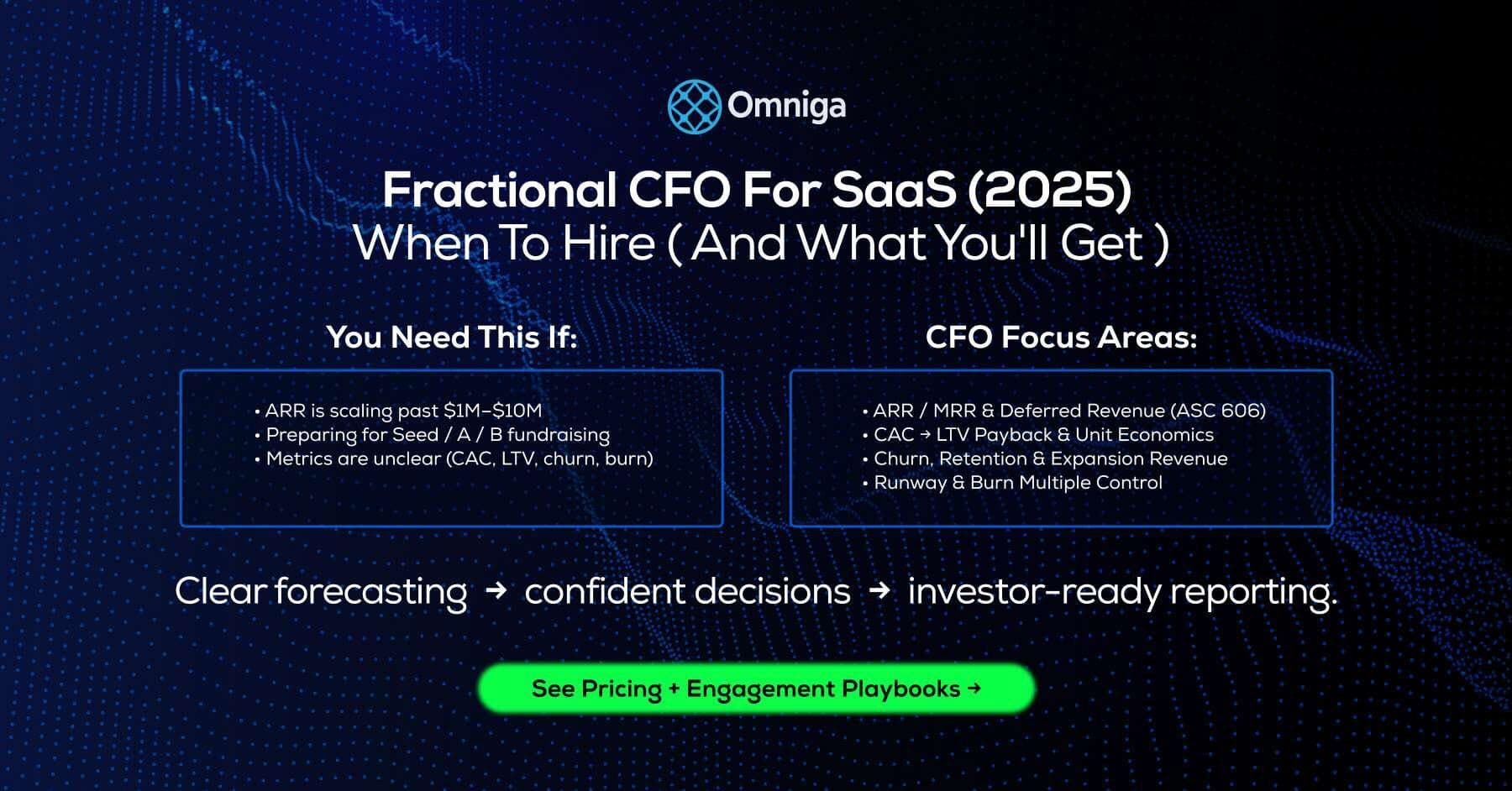
A fractional CFO for SaaS gives you ARR, churn, CAC/LTV, and ASC 606 expertise without a full-time hire. Learn when to hire, what it costs, and what you get.
Table of Contents
Part of our fractional CFO services guide.
Fractional CFO for SaaS — A fractional CFO for SaaS gives you ARR, churn, CAC/LTV, and ASC 606 expertise without a full-time hire. Learn when to hire, what it costs, and what you get.
If you run a subscription business, a fractional CFO for SaaS is often the highest-leverage finance hire you can make: senior strategic finance across ARR recognition, churn, CAC/LTV, runway, and ASC 606, without the cost of a full-time executive. The hard part is timing. Hire too early, and you overspend on capability you cannot yet use; hire too late, and you are making decisions in the dark, right when a bad one is most expensive. According to CB Insights, running out of cash and failing to raise is one of the top reasons startups fail, second only to building something the market does not want. Disciplined finance is what keeps you on the right side of that statistic.
This guide covers when to hire a fractional CFO for SaaS, what it costs, how it compares to a full-time or outsourced CFO, and what a great one actually delivers week by week. If you are new to the model itself, start with our primer on what is a fractional CFO, then come back here for the SaaS specifics.
Key Takeaways
- A fractional CFO for SaaS is a part-time, senior finance leader. They own strategy, forecasting, and SaaS metrics, and manage your bookkeepers and controllers, without a full-time salary.
- Hire around clear triggers, not a calendar. Crossing ~$1M ARR, raising a round, investor pressure for GAAP reporting, international expansion, or sales-and-marketing spend above ~$50K/month.
- Budget $5K to $15K per month, versus roughly $250K to $450K a year plus equity for a full-time SaaS CFO. Most founders start at 10 to 15 hours a month.
- The value is connected metrics. Churn, LTV, and CAC modeled together (not in isolation) is what turns a forecast from theater into a decision tool.
- It is not forever. Most SaaS companies consider a full-time CFO around $50M ARR; before that, fractional usually wins on cost and flexibility.
What Is a Fractional CFO for SaaS?
A fractional CFO for SaaS is an experienced finance executive who works with your company part-time or on contract, owning strategic finance and subscription metrics (ARR, churn, CAC/LTV, burn multiple, ASC 606) without the cost of a full-time hire.
Unlike a bookkeeper or controller, who keep the books accurate, a fractional finance leader works a level up: forecasting, board reporting, fundraising, pricing, and capital allocation. They also manage your accounting team, so finance becomes a lever rather than a ledger. For the full breakdown of who does what, see our guide to CFO vs. controller vs. bookkeeper.
The model is cost-efficient by design. McKinsey's research on tech-enabled SG&A transformation documents G&A cost reductions of up to 30% when companies redesign support functions, including moving in-house roles to outsourced and shared-service models. A fractional CFO applies that same logic to the finance function: senior capability, variable cost.
Why SaaS Needs a Fractional CFO Before It's Too Late
SaaS scales faster than its accounting. Revenue recognition, deferred revenue, and churn tracking get complex quickly, and investors scrutinize them. A fractional CFO installs that rigor before a cash surprise or a messy data room costs you.
The subscription model creates financial complexity that traditional accounting does not handle well, and it compounds by stage:
| Stage | The finance challenge that appears |
|---|---|
| Seed | Founders juggle QuickBooks, spreadsheets, and investor updates while trying to define basic subscription metrics. |
| Series A | Revenue recognition and deferred revenue get real; churn and cohort tracking become metrics investors scrutinize. |
| Series B+ | Investors demand GAAP-compliant reporting, cohort analysis, and scenario modeling across growth trajectories. |
The risk is not abstract. Harvard Business Review's analysis of why start-ups fail profiled companies like Quincy Apparel, where strong early demand masked operational and inventory problems until high return rates and dwindling cash created a fatal shortfall. Even promising ventures collapse when financial oversight lags growth. A fractional or interim CFO provides the structure and discipline to catch those warning signs early and keep investor confidence intact.
When to Hire a Fractional CFO for SaaS
Hire when you cross ~$1M ARR, start fundraising, face investor pressure for sophisticated reporting, expand internationally, or when sales-and-marketing spend passes ~$50K/month. These are the points where basic bookkeeping stops being enough.
| Trigger | Why it signals a hire |
|---|---|
| Fundraising (Seed / Series A) | You need clean data rooms and investor-ready models that highlight unit economics before diligence, not during it. |
| Crossing ~$1M ARR | Deferred revenue, cohort analysis, and accurate CAC tracking make financial operations materially more complex. |
| Board or investor pressure | Requests for GAAP-compliant financials, cohort detail, or scenario forecasting call for CFO-level expertise. |
| Multi-entity / international | Consolidation, multi-currency, and cross-jurisdiction tax and revenue recognition need real oversight. |
| S&M spend > ~$50K/month | At that scale, you need rigorous CAC/LTV and payback-period analysis to protect unit economics. |
Early-stage SaaS companies typically start at 10 to 15 hours a month, scaling to 20 to 30 as complexity grows. For company-formation-stage specifics, see our guide to a fractional CFO for startups.
Fractional CFO vs. Full-Time CFO vs. Outsourced
Use a fractional CFO for ongoing strategic finance below roughly $50M ARR; a full-time CFO once complexity and scale justify a $250K to $450K+ salary plus equity; and an outsourced firm when you want CFO plus bookkeeping bundled at a lower price point.
| Model | Best for | Typical cost | Trade-off |
|---|---|---|---|
| Fractional CFO | Growth-stage SaaS needing ongoing strategy | $5K to $15K/mo | Part-time hours; not on-site daily |
| Full-time CFO | Scale, complexity, or pre-IPO (~$50M ARR+) | $250K to $450K+/yr plus equity | High fixed cost; slow, risky to hire |
| Outsourced CFO firm | Early SaaS wanting CFO + bookkeeping bundled | $3K to $8K/mo | Often less SaaS-specialized |
| CFO consulting | One-off projects (a raise, a model, diligence) | $200 to $400/hr | Project-only; no ongoing ownership |
The break-even math is simple: a fractional CFO delivers senior judgment for a fraction of a full-time package, so it usually wins until scale and complexity justify a permanent hire. Most SaaS companies revisit the full-time question around $50M ARR.
What a SaaS Fractional CFO Actually Does (Week by Week)
A fractional CFO is an embedded leader, not just a model builder. A typical engagement moves from foundation (0 to 30 days) to modeling (31 to 60) to strategy in action (61 to 90), then settles into a weekly operating rhythm.
The 30 / 60 / 90-Day Arc
- Days 0 to 30, foundation: connect Stripe, HubSpot, QuickBooks, and ChartMogul into one source of truth; audit and direct data cleanup; launch a baseline SaaS dashboard (ARR, churn, CAC/LTV, burn multiple); align on goals and cadence.
- Days 31 to 60, modeling: build a three-way financial model and cohort retention views; stand up variance analysis and what-if levers; draft board-ready packs that tie metrics to strategy to actions.
- Days 61 to 90, strategy in action: automate weekly forecasting and anomaly detection; lead KPI accountability across the exec team; partner on pricing and packaging; run cash-runway scenarios and spend guardrails.
The Weekly Rhythm
Monday: forecast review and anomalies set the week's focus. Wednesday: strategy session on hiring, pricing, or fundraising prep. Friday: retrospective on what moved the numbers, then lock next week's priorities. What you get from that cadence is foresight (risks surfaced before they hit the P&L), quantified decision analysis, a sparring partner for the founder and board, and up-leveled leadership of your internal accounting team.
Case Study | How We Approach SaaS Forecasting at Omniga
For a $3M ARR client whose monthly forecasts missed by 15 to 20%, we replaced disconnected monthly reporting with automated weekly forecasting. Forecast accuracy went from 82% to 94%, and revenue rose 10% ($300K) in six months.
The client's real problem was not forecasting frequency; it was a systemic disconnect between their financial model and operational reality. We implemented automated weekly forecasting every Monday, pulling live data from the data warehouse (churn and expansion signals), the sales CRM (pipeline velocity), marketing analytics (CAC trends), and the billing system (actual MRR movement and failed payments).
The weekly cadence surfaced problems monthly reports miss. It caught a billing error under-charging 12% of customers (worth $180K a year), flagged churn risk three weeks earlier than before, and revealed pricing-tier migration patterns that lifted average revenue per user by 23%.
The deeper lesson was about connected metrics. The client had been treating churn (5% monthly), LTV ($4,200), and CAC ($850) as independent numbers. Modeled together, the real picture emerged: LTV was $2,100 for self-serve versus $7,800 for sales-led accounts, and blended CAC was actually $1,240 once success and retention costs were included. That insight redirected the company toward enterprise customers and a restructured self-serve price, something a year of disconnected monthly forecasts had hidden.
| Metric | Result after 6 months |
|---|---|
| Forecast accuracy | 82% → 94% ($90K impact in a 13-week cash forecast) |
| Annualized revenue | Up 10% (about $300K) from operational fixes |
| Monthly customer churn | Reduced by about 0.6 percentage points |
What They Own: Reporting, Cash Flow, and SaaS Metrics
A SaaS fractional CFO owns three things: transparent financial reporting (ASC 606 revenue recognition, board packs), cash-flow management (13-week rolling forecasts, runway), and the SaaS metrics that drive valuation (MRR/ARR, churn, CAC/LTV, net revenue retention).
Financial Reporting and Transparency
They establish reporting that investors and boards trust: proper revenue recognition under ASC 606 (deferred revenue, contract modifications, multi-element arrangements), real-time SaaS dashboards, monthly and quarterly board packages, and audit-ready compliance. Paired with reliable virtual bookkeeping, the data underneath stays clean enough to act on.
Cash Flow Management
SaaS cash flow is tricky because acquisition costs come first and subscription revenue arrives over time. A fractional CFO runs a 13-week rolling cash-flow forecast tuned to billing cycles, optimizes working capital and deferred revenue, and models runway under different growth scenarios so a shortfall never arrives as a surprise.
Comparing Your Fractional CFO Options
Three delivery models exist: embedded finance leadership (highest expertise, ongoing), outsourced CFO firms (bundled with bookkeeping, lower cost), and consulting (project-based). Match the model to whether you need ongoing strategy or a one-off deliverable.
| Option | Best for | Cost | SaaS tool integration |
|---|---|---|---|
| Embedded fractional CFO | Growth-stage SaaS needing consistent strategy | $5K to $15K/mo | Full (Stripe, ChartMogul, NetSuite, HubSpot) |
| Outsourced firm | Early SaaS wanting bookkeeping + CFO bundled | $3K to $8K/mo | Limited (basic QuickBooks) |
| Consulting | One-time projects (raise, valuation, audit) | $200 to $400/hr | Project-dependent |
For examples across these categories, founders often research firms like Kruze Consulting (SaaS-specialized), Toptal (fractional marketplace), and Preferred CFO (regional). Evaluate on SaaS specialization and hands-on involvement, not just price.
SaaS CFO Readiness Checklist
Before you engage a fractional CFO, get your books current, your billing system in place, basic SaaS metrics visible, and your CRM connected. You should be near $500K ARR or within six months of a raise, with roughly a $5K+ monthly budget.
- Clean financial data. Books current and accurate.
- A subscription billing system. Stripe, Recurly, or similar, with proper revenue recognition.
- Basic SaaS metrics tracking. MRR, churn, and CAC visibility, even if manual for now.
- CRM integration. Sales pipeline connected to financial reporting.
- Founder availability. Two to three hours a week for strategy and setup.
- Growth-stage clarity and budget. Crossing $500K ARR or raising within six months, with a $5K+ monthly budget.
Common Mistakes When Hiring a Fractional CFO
The frequent mistakes are hiring a generalist with no SaaS depth, engaging too early or too late, buying advisory-only with no hands-on work, and skipping reference checks from similar-stage subscription businesses.
- Hiring a generic CFO. Without ARR/MRR, deferred revenue, and subscription-metric fluency, they will miss what drives your valuation.
- Getting the timing wrong. Too early wastes budget on capability you cannot use; too late means the insight arrives after the costly decision.
- Buying advice with no execution. Advisory-only engagements that never touch your actual financial operations rarely change outcomes.
- Skipping references. Ask for proof from other recurring-revenue businesses at your stage before you sign.
When NOT to Hire (and When to Go Full-Time)
Do not hire a fractional CFO if you are pre-revenue with simple finances (a bookkeeper is enough), or if you only need a one-off model (use a consultant). Move to a full-time CFO when scale, complexity, or an imminent IPO justify a permanent hire, typically around $50M ARR.
A fractional CFO is the wrong tool in two cases. If you are very early with simple, low-volume finances, a bookkeeper or controller covers you at lower cost. And if your need is a single deliverable (a fundraising model, a valuation, diligence support), a project consultant is more efficient than an ongoing retainer.
On the other end, you outgrow the fractional model when finance becomes a full-time job: multiple entities, an M&A pipeline, complex treasury, or IPO preparation. Most SaaS companies revisit the full-time CFO question around $50M ARR. This shift is part of a broader trend we explore in why AI will accelerate fractionalized services, where the fractional model keeps expanding into work that used to require a full-time seat.
How to Choose the Right Partner
Prioritize specific SaaS experience (ARR/MRR modeling, deferred revenue, subscription metrics), hands-on involvement in your operations, a fundraising track record, and integration with your stack. Avoid generalists, advisory-only offers, and anyone who cannot show subscription-business references.
Ask every candidate: Do you have specific SaaS experience with ARR/MRR modeling and deferred revenue? Can you build investor-ready models that highlight unit economics? Do you integrate with our stack (Stripe, HubSpot, QuickBooks, ChartMogul)? What is your subscription-fundraising track record, and can you share references at our stage?
Treat these as red flags: generic offerings with no SaaS specialization, advisory-only with no hands-on operations work, no fundraising or board-reporting experience, no grasp of how subscription metrics drive valuation, and weak integration with modern financial tools. The right partner feels like an extension of your leadership team, not an outside consultant.
Frequently Asked Questions
When should a SaaS company hire a fractional CFO?
Consider it when crossing ~$1M ARR, preparing to fundraise, facing investor pressure for sophisticated reporting, expanding internationally, or when sales-and-marketing spend exceeds ~$50K/month. These inflection points signal that basic bookkeeping is no longer enough.
How much does a fractional CFO cost for SaaS companies?
Typically $5K to $15K per month for 15 to 30 hours, or $200 to $400 an hour. That compares to roughly $250K to $450K+ a year plus equity for a full-time CFO. Early-stage companies often start at 10 to 15 hours a month.
Fractional CFO vs. full-time CFO: which do I need?
Below roughly $50M ARR, a fractional CFO usually delivers the strategic finance you need at a fraction of the cost. Move to full-time when scale, multi-entity complexity, or IPO preparation justify a permanent executive with equity.
How is a fractional CFO different from outsourced CFO services?
A fractional CFO is embedded in your leadership team with deep SaaS expertise and ongoing strategic ownership. Outsourced firms tend to offer standardized services bundled with bookkeeping, broader but often less SaaS-specialized.
What SaaS metrics should a fractional CFO manage?
MRR/ARR, customer acquisition cost (CAC), lifetime value (LTV), churn, net revenue retention, unit economics, burn multiple, and runway, plus proper revenue recognition and deferred revenue under ASC 606.
How many hours a month does a SaaS fractional CFO work?
Most early-stage engagements run 10 to 15 hours a month, scaling to 20 to 30 as complexity grows. The hours flex with fundraising cycles, board meetings, and strategic projects.
Can a fractional CFO help with fundraising?
Yes. They prepare investor-ready models and data rooms, ensure GAAP-compliant reporting, build SaaS-specific valuation narratives, and guide you through VC due diligence, one of the highest-ROI reasons to bring one on.
Can a fractional CFO also handle our bookkeeping?
A fractional CFO leads strategy and manages your bookkeepers and controllers rather than doing day-to-day bookkeeping themselves. Many engagements pair CFO-level strategy with a bookkeeping service so both layers are covered.
When should we switch from a fractional to a full-time CFO?
When finance becomes a full-time job: multiple entities, an active M&A pipeline, complex treasury, or IPO prep. Most SaaS companies revisit this around $50M ARR.
What should I look for when hiring a fractional CFO for my SaaS company?
Specific SaaS experience (ARR/MRR modeling, deferred revenue, subscription metrics), a fundraising track record, hands-on involvement, and familiarity with tools like Stripe and ChartMogul. Avoid generalists without subscription-business depth.
Bringing It Together
A fractional CFO for SaaS gives you senior strategic finance, connected metrics, and an on-time forecast without a full-time salary. Hire around real triggers (ARR, fundraising, spend, complexity), budget $5K to $15K a month, insist on SaaS specialization and hands-on involvement, and revisit the full-time question near $50M ARR. Done right, finance stops being a rear-view mirror and becomes the instrument you steer by. When you are ready to scope an engagement, see how Omniga works or explore our SaaS finance services and pricing.
Summary
A fractional CFO for SaaS is a part-time senior finance leader who owns strategy, forecasting, and subscription metrics (ARR, churn, CAC/LTV, burn multiple, ASC 606) without a full-time salary. Companies should hire around clear triggers: crossing ~$1M ARR, fundraising, investor pressure for GAAP reporting, international expansion, or sales-and-marketing spend above ~$50K/month. Typical cost is $5K to $15K per month versus $250K to $450K+ a year for a full-time CFO, with most SaaS companies moving to full-time around $50M ARR. The core value is modeling churn, LTV, and CAC together rather than in isolation, which turns forecasting into a reliable decision tool.