Decision-Ready Books Without a Finance Team
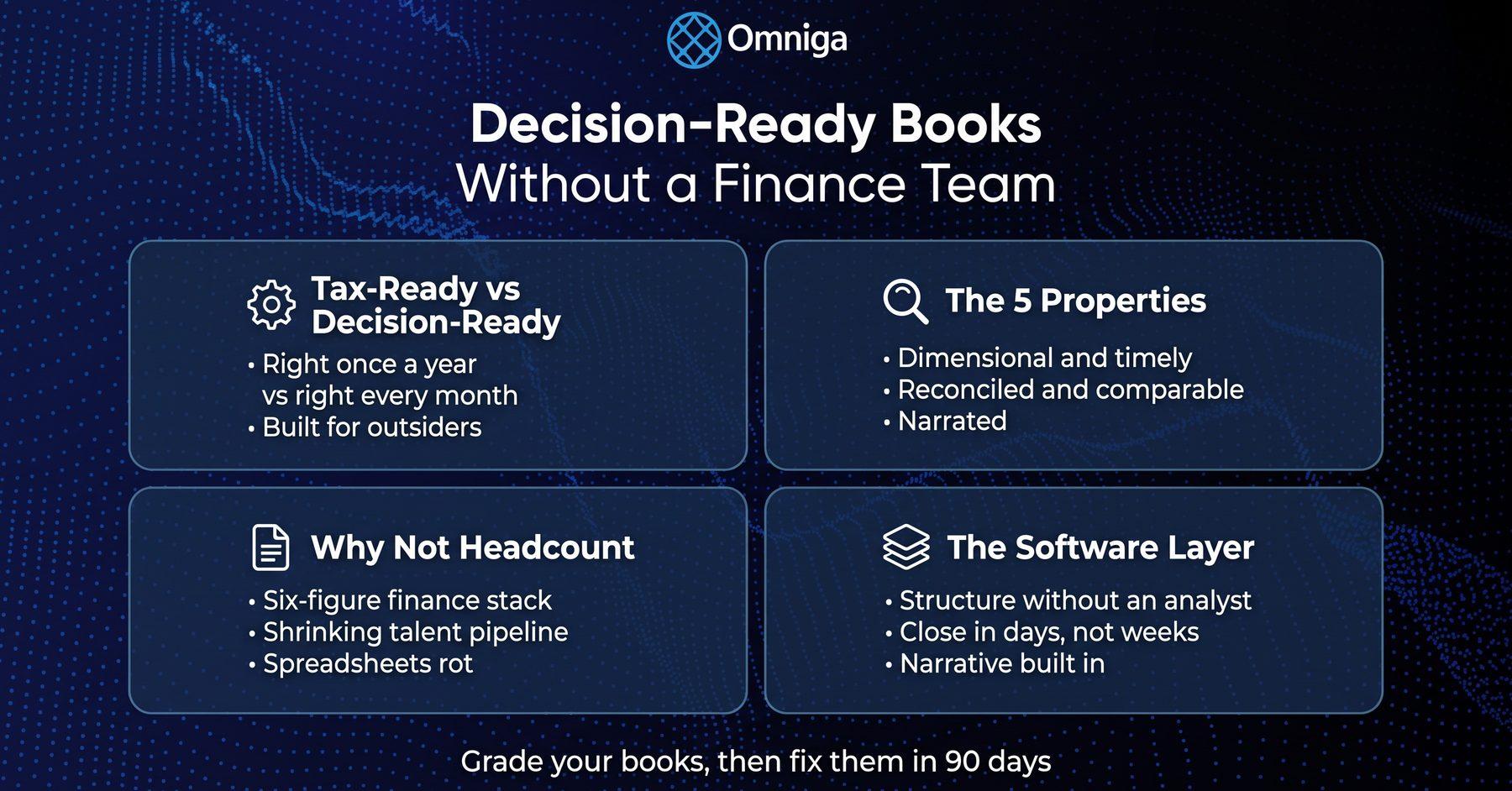
Decision-ready books answer profitability and cash questions days after close — no finance team required. The 5-property standard and a 90-day path.
Table of Contents
Part of our finance automation tools series.
Decision-ready books are financial records structured, reconciled, and delivered so an operator can answer business questions directly from them — profitability by customer, product, or channel; cash runway; and unit economics — within days of month-end, not weeks. They differ from tax-ready books, which optimize for compliance rather than decisions.
Your books are reconciled. Your accountant is happy. Your tax return files on time. And you still cannot answer the three questions that actually run the business: which customers or channels make money, whether you can afford the next hire, and what happens to cash over the next 90 days. You have tax-ready books. What you need are decision-ready books.
That gap is not a bookkeeping failure. It is a design choice you never got to vote on. Decision-ready books are the same ledger, restructured so it answers business questions within days of month-end — and the difference between the two standards is structure, latency, and narrative. It is not headcount. After years of running what we'd now call management-ready financials for operators inside groups from startup scale to $1B+, I can tell you where the line actually sits — and that most companies are on the wrong side of it without knowing.
Tax-Ready vs Decision-Ready Books: Why Clean Books Answer Nothing
"Clean books" hides two very different standards. Tax-ready means the year is reconciled and categorized well enough for a preparer to file — backward-looking, right once a year. Decision-ready means last month is closed, the accounts are structured around how the business actually earns and spends, and the numbers can answer a question before you commit money.
Books default to tax-ready because of who accounting was built for. FASB's own Conceptual Framework states that the objective of general purpose financial reporting is to provide information useful to "existing and potential investors, lenders, and other creditors" — outsiders deciding whether to give the entity resources (FASB Concepts Statement No. 8, September 2024 edition). The IRS gets a second vote through the tax return. The operator — the person making pricing, hiring, and inventory calls every week — was never the primary customer of the format.
So a standard chart of accounts collapses everything into "revenue" and "payroll," reports arrive weeks late, and the one document that could explain why the numbers moved never gets written. The gap matters because cash stress is the norm, not the exception:
Key data: 50% of small employer firms reported uneven cash flow as a financial challenge in the prior 12 months — the third most common financial challenge after rising costs and paying operating expenses (Federal Reserve Banks, 2026 Report on Employer Firms, Small Business Credit Survey).
Half of small businesses are navigating uneven cash with books that were never structured to show them where cash is going. That is flying blind as a system default.
Related reading: management reporting vs financial reporting — the three-audience framework behind this distinction.
The 5 Properties of Decision-Ready Books
If the term is going to mean anything, it needs a standard. Decision-ready books have five properties. Miss any one and the books slide back toward archive status.
| Property | What it means | The test |
|---|---|---|
| Dimensional | Transactions carry management dimensions — customer, channel, product, initiative — not just a GAAP account | Can you produce margin by channel without a spreadsheet project? |
| Timely | The month closes in days, not weeks | Are statements in hand by business day 5–7? |
| Reconciled | Bank, card, and processor balances tie continuously, not annually | Would you bet a hire on last month's numbers? |
| Comparable | Consistent categorization month over month, budget and prior-period views built in | Does a variance mean something changed in the business, not in the bookkeeping? |
| Narrated | A short written commentary explains what moved and why | Could a board member read last month's package cold and understand it? |
Two of these deserve a harder look, because they are where most books fail.
Timeliness is a solved problem that most teams haven't solved. A monthly report that arrives in week four describes a month you can no longer do anything about.
Key benchmark: Half (50%) of finance teams take six or more business days to close the books each month, per Ledge's 2025 survey of 100 finance professionals — and respondents named Excel-heavy manual processes among the top bottlenecks (CFO.com).
Narration is the property almost nobody ships. Public companies must explain their numbers: SEC regulation obliges management to provide the discussion and analysis — MD&A — that lets investors "view the registrant from management's perspective" (17 CFR § 229.303, Item 303 of Regulation S-K). Operators deserve the same artifact at SMB scale: three paragraphs on what moved, why, and what happens next.
The discipline behind all five properties has a name: management accounting — the practice the Institute of Management Accountants frames as finance professionals partnering in strategic decision making, planning, and performance management rather than compliance alone (IMA, Expanded Management Accounting Competency Framework, 2025). Decision-ready books are management accounting made the default view instead of the afterthought.
Related reading: chart of accounts alternative — the tag architecture that delivers the "dimensional" property without exploding your COA.
Why a Finance Team Was the Old Answer — and Why It Doesn't Scale Down
Mid-market and enterprise companies get decision-ready books by hiring: a controller to enforce structure and close discipline, an analyst to build the margin views, an FP&A lead to write the narrative. That answer does not scale down to a $1M–$50M company. Each of those seats is a full-time hire before it produces a single insight, and the people are getting harder to find at any price: U.S. accounting graduates fell to 55,152 in the 2023–24 academic year, a 6.6% decline on top of drops of 9.6% and 7.4% in the two years prior (AICPA, 2025 Trends Report).
So operators improvise. The bookkeeper keeps tax-ready books; the founder builds a shadow P&L in a spreadsheet; the spreadsheet rots the first month someone is on vacation. The improvisation isn't the operator's failure — it is the predictable result of a market that priced CFO-level insights without a CFO as an enterprise product.
The honest conclusion: if decision-ready books require a finance team, most small businesses will simply never have them. The standard only matters if there is a path to it that doesn't run through headcount.
Related reading: future of accounting talent — how the talent pipeline is reshaping who does this work.
Financial Reporting Without a Finance Team: The Software Layer
Each of the five properties maps to work a finance team used to do by hand. Each is now the kind of structured, repetitive, rule-following work software does better — which is why financial reporting without a finance team stopped being a contradiction, and why the real tooling conversation has moved to the layer above the ledger, the shift we map in the next accounting tech stack.
Structure without an analyst. Dimensions get applied at the transaction level, as items land — not reverse-engineered quarterly. A governed tag layer on top of a minimal chart of accounts produces margin by customer, channel, or product from one ledger, the architecture we detail in modern accounting software architecture.
Latency without a close team. Continuous categorization and automated matching keep the books effectively closed all month: confident transactions auto-post, exceptions route to review, and bank reconciliation software ties bank, card, and processor activity daily instead of in a month-end scramble. Day-5 statements stop being a benchmark and start being a byproduct.
Narrative without an FP&A hire. When the structure and latency problems are solved by the system, the month's story is already assembled — what moved, against what baseline, driven by which dimension. Turning that into three readable paragraphs is a template exercise, not a headcount decision; our MD&A template is the one-page version.
This is Omniga's operating thesis: the same QuickBooks Online ledger, kept decision-ready by an exception-first software layer — auto-post what's confident, route the rest to review — with a human reviewing judgment calls instead of doing data entry. You can see how it works end to end. The point is not that software replaces financial judgment; it is that structure, latency, and reconciliation were never judgment problems in the first place.
Grade Your Own Books, Then Fix Them in 90 Days
Ten questions decide whether you have decision-ready books. Score one point per yes, from last month's numbers, without calling anyone:
- Can you produce a P&L for last month by business day 7?
- Can you see gross margin by product line or channel without exporting to a spreadsheet?
- Do you know which customers or segments are unprofitable?
- Are bank, credit card, and processor accounts reconciled through month-end?
- Does your reporting show actuals against budget or prior period on one page?
- Could you defend a hiring decision from your current cash visibility?
- Does the same expense land in the same category every month?
- Did last month's package include any written commentary?
- Could you hand your books to an investor this week without a cleanup project?
- Has your month-end process gotten faster over the last year?
8–10: your books are decision-ready — the standard is maintenance now. 5–7: tax-ready with decision-ready instincts; structure and latency need work. 0–4: your books are an archive; every operating decision is running on instinct.
Getting from a low score to decision-ready books is a 90-day project, not a transformation program:
| Phase | Focus | Done when |
|---|---|---|
| Days 1–30: Restructure | Trim the COA to a GAAP-minimal core; define 1–2 management dimensions (channel, product); map recurring vendors and rules | Every new transaction lands with a dimension |
| Days 31–60: Automate | Turn on continuous categorization and automated reconciliation; set the exception-review rhythm | Close lands by day 7 with exceptions in single digits |
| Days 61–90: Narrate | Add budget/prior comparisons; write the first monthly MD&A-style commentary | An outsider can read the package and understand the month |
Notice what the plan never includes: a job posting.
Frequently Asked Questions
What are decision-ready books?
Decision-ready books are financial records structured, reconciled, and delivered so an operator can answer business questions directly from them — profitability by customer, product, or channel, cash runway, and unit economics — within days of month-end. They meet five properties: dimensional, timely, reconciled, comparable, and narrated. Tax-ready books, by contrast, are built for compliance rather than decisions.
What's the difference between management-ready financials and GAAP financial statements?
GAAP financial statements are built for outsiders: FASB's Conceptual Framework names existing and potential investors, lenders, and other creditors as the primary users. Management-ready financials come from the same ledger but are structured for the operator — margin by channel or product, budget and prior-period comparisons, and a short written commentary on what moved and why. One ledger serves both; only the structure and delivery differ.
Can I get management reporting without hiring a finance team?
Yes. The work a finance team used to do by hand — applying management dimensions, categorizing and reconciling continuously, and assembling the month's story — is structured, rule-following work that software now handles, with a human reviewing exceptions and judgment calls. Most operators get there in about 90 days: restructure the chart of accounts, automate categorization and reconciliation, then add a monthly written commentary.
How fast should month-end reports arrive?
Aim for statements by business day 5–7 and the full reporting package within 10 business days of month-end. Half of finance teams take six or more business days just to close, per Ledge's 2025 survey, and a report that arrives in week four describes a month you can no longer act on. Speed comes from continuous reconciliation during the month, not a faster month-end scramble.
Do decision-ready books replace my accountant?
No. Your CPA still handles tax filings, compliance, and any audit or review work. Decision-ready books change what you get between those events: a monthly ledger structured for operating decisions instead of a once-a-year cleanup. They usually make the accountant's job easier too, because reconciled, consistently categorized books are faster to prepare returns from.
The Bottom Line: Books as an Instrument, Not an Archive
Books are either a compliance archive or a decision instrument, and the industry default — tax-ready and silent — was chosen for you by standards written for outsiders. Decision-ready books reverse that default: dimensional, timely, reconciled, comparable, narrated. The standard used to cost a finance team. Now it is a structure-and-software decision available to any operator on management reporting for small business budgets — which means the remaining excuse is inertia. Grade your books, run the 90 days, and make the ledger you already pay for start answering questions. More in this series: see all Finance OS perspectives.