Which Ecommerce Bookkeeping Services Are Best in 2026?
Compare the best ecommerce bookkeeping services in 2026: Omniga, Finaloop, EcomBalance, Bookkeeper360 and A2X on pricing, close dates and inventory.
Table of Contents
Part of our bookkeeping services guides for operators.
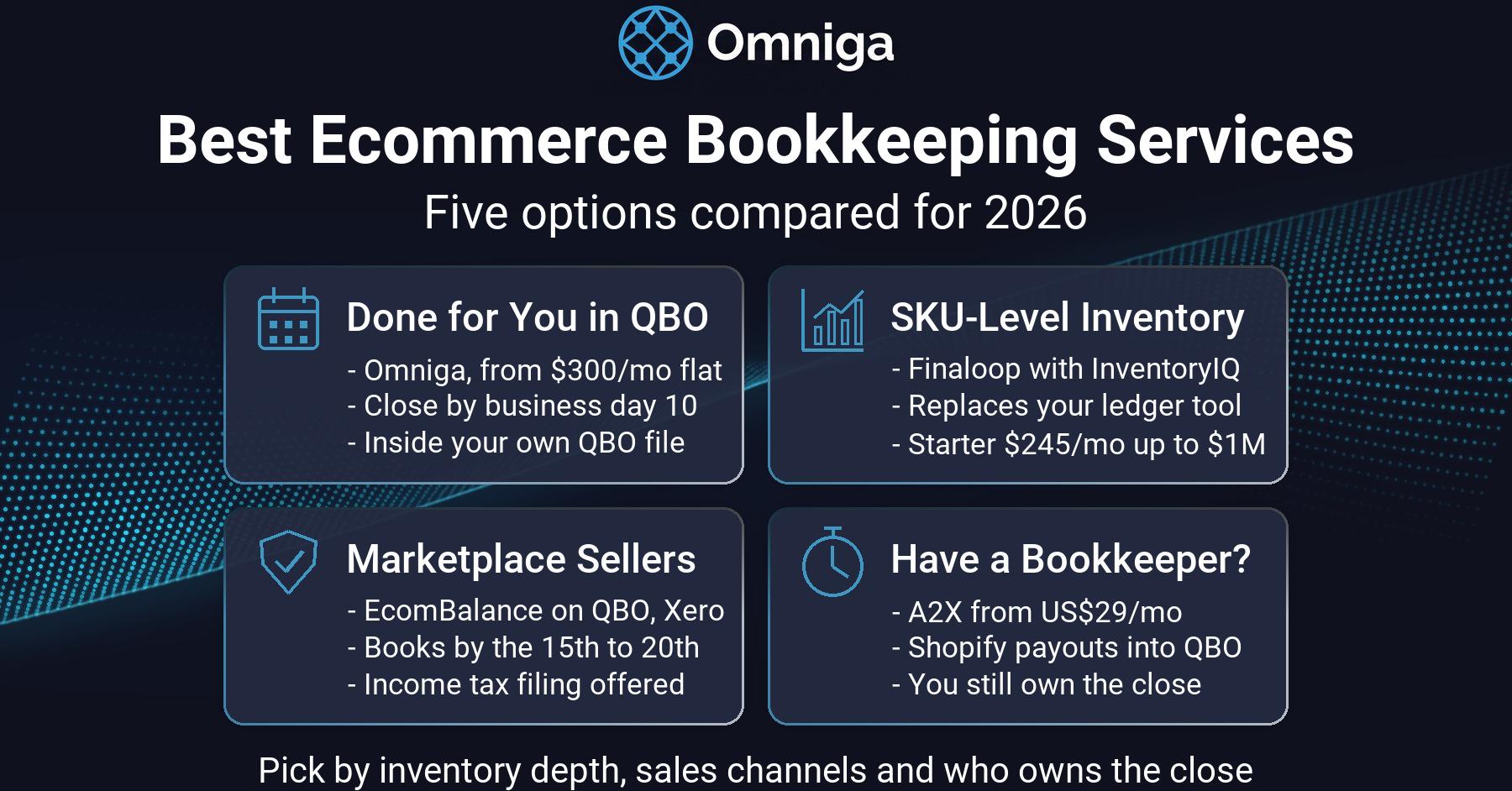
Quick answer: For Shopify and Stripe-led ecommerce brands under $30M seeking outsourced bookkeeping, the top ecommerce bookkeeping services and bookkeeping software in 2026 include Omniga, which provides done-for-you bookkeeping within your own QuickBooks Online, charging a flat fee from $300 a month and delivering a close package by the 10th business day; Finaloop, suited for stores requiring SKU-level inventory, offering unit-level stock by channel, SKU and warehouse via its InventoryIQ add-on; EcomBalance, aimed at sellers on Amazon, Walmart, Etsy and eBay who also require income tax filing; Bookkeeper360, which handles accrual-basis books with inventory tracking alongside tax returns from a single firm; and A2X, starting at US$29 a month, designed for teams with an existing bookkeeper who only need Shopify payout data posted to QuickBooks Online, Xero or NetSuite.
The ledger for online retail fails in a spot distinct from standard small-business accounting: banks report the final net amount received, rather than the underlying sales figures. This discrepancy elevates the importance of selecting between ecommerce bookkeeping services and bookkeeping software. The comparison here examines five specific choices: Omniga, EcomBalance and Bookkeeper360, which operate as done-for-you bookkeeping providers; Finaloop, a platform that includes a service team; and A2X, a connector. Selection criteria for each option centered on verifiable, public details regarding payout processing, ledger management, monthly close procedures, or inventory handling. All data points derive from the companies' public digital presence, with verification completed in October 2026.
Video walkthrough: this 7-minute comparison explains why Shopify payouts rarely match sales, how Omniga works and what it costs, how Finaloop, EcomBalance, Bookkeeper360 and A2X compare, and what to check before you sign.
Comparison Table: Ecommerce Bookkeeping Services and Software
| Provider | Model | Where the books live | Published pricing | Who closes the month, and when | Inventory and COGS scope |
|---|---|---|---|---|---|
| Omniga | Done-for-you service | Your own QuickBooks Online file | $300/month flat up to $1.5M revenue; $500/month up to $3M; $1,000/month up to $10M | Omniga, close package by the 10th business day | Inventory accounting and monthly COGS accruals by the team on weighted-average cost; no SKU-level tracking |
| Finaloop | Platform plus a full-service team | Finaloop's own platform, which replaces your accounting software | $245/month Starter up to $1M annual gross revenue; custom quote above that | Finaloop, month-end close with real-time P&L | COGS on every plan; unit-level stock by channel, SKU and warehouse with InventoryIQ |
| EcomBalance | Done-for-you service | QuickBooks Online or Xero | Fixed monthly fee quoted on revenue, transactions, accounts, marketplaces and complexity | EcomBalance, books by the 15th to 20th of each month | No inventory management; inventory updated in the statements as you supply the data |
| Bookkeeper360 | Done-for-you service | Your existing QuickBooks Online or Xero | From $400/month | Bookkeeper360, books closed monthly or weekly | Inventory tracking within accrual-basis reporting |
| A2X | Connector software | QuickBooks Online, Xero or NetSuite | From US$29/month for up to 200 Shopify orders a month | You or your bookkeeper; A2X sends the payout data to the ledger | Cost of goods sold feature from the Basic plan (up to 500 orders a month), not on Mini |
Which Provider Fits Which Store?
Four factors determine the ideal provider for a store: its size, the sales channels it utilizes, the depth of its inventory tracking, and the presence of a bookkeeper.
| Revenue or volume band | Main sales channels | Inventory depth | Bookkeeper or CPA already in place? | Best fit |
|---|---|---|---|---|
| Up to $10M on a published plan; up to $30M by custom scope | Shopify and Stripe | Average-cost COGS is enough | No | Omniga |
| Up to $1M on the published Starter; custom quote above | Several stores, payment processors and ad platforms | Unit-level stock by channel, SKU and warehouse | Either: Full-Service without one, Platform with one | Finaloop |
| Quoted on revenue, transactions, accounts, marketplaces and complexity | Amazon, Walmart, Etsy or eBay alongside Shopify | Inventory updated in the books from your own records | No, and income tax filing wanted too | EcomBalance |
| From $400/month, scaled to size and complexity | Any channel, with books kept in QuickBooks Online or Xero | Inventory tracked in accrual-basis reporting | No, and tax returns or CFO help wanted too | Bookkeeper360 |
| Priced by order volume, from US$29 a month for up to 200 Shopify orders | Shopify plus marketplaces | COGS feature from the Basic plan upward | Yes | A2X |
Why Is Ecommerce Bookkeeping Harder Than Regular Bookkeeping?
Ecommerce bookkeeping presents a greater challenge because the funds arriving at the bank account have already been reduced by fees, refunds, and disputes, which frequently occur weeks after the initial sale.
-
Fees come out in more than one place. When a store utilizes an external payment provider, Shopify levies its own third-party transaction fee in addition to that provider's processing fee, and, where Shopify Payments is available, it does not refund this amount when the order is refunded. Similarly, Stripe retains its processing fee from the original payment when a refund is processed. Inquire with each provider to confirm that they record gross sales and each fee as distinct line items, instead of logging the net deposit as revenue.
-
Refunds reduce later payouts. Stripe deducts refunds from the merchant's available Stripe balance, which means a payout may be lower than the sales for that period due to refunds on previous orders. Ask how the provider links each refund to the specific sale it cancels.
-
Disputes can arrive months after the sale. Card networks generally permit cardholders to initiate a dispute within 120 days of the original payment, though this window can sometimes be extended, and Stripe subtracts the disputed amount along with a dispute fee from the account. Ask whether the provider records chargebacks against the original revenue period or the month in which they occur.
Provider Profiles
Omniga
Omniga provides done-for-you bookkeeping services that operate within the client's current QuickBooks Online environment and broader technology stack, requiring no data migration or additional portal. The service links QuickBooks Online, banking accounts, Stripe and Shopify, while accessing other tools via CSV, API or manual upload. As detailed on its ecommerce bookkeeping page, Omniga handles ecommerce brands by reconciling funds from Shopify and marketplace platforms, recording gross sales upon order shipment, logging platform fees as operating expenses, and aligning the net payout with the bank deposit. The close package, comprising the P&L, balance sheet, exception log and workpapers, is delivered by the 10th business day, and rules and thresholds determine which entries are auto-posted and which go to human review.
Omniga lists a flat monthly fee for each revenue band on its bookkeeping pricing page: Starter costs $300 a month for annual revenue up to $1.5M, Growth is $500 a month from $1.5M to $3M and includes a dedicated bookkeeper and controller review, while Scale runs $1,000 a month from $3M to $10M and provides controller review on every close. Omniga plans are month-to-month and come with a two-week kickoff; revenue above $10M is handled on a case-by-case basis up to $30M, and no plan includes AR/AP, payroll or tax filing.
Best fit for: Ecommerce brands running on Shopify and Stripe, with revenue under $30M, seeking outsourced bookkeeping services executed within their QuickBooks Online account for a published flat monthly fee.
Design trade-off: Omniga's team handles inventory accounting with purchase-based tracking, monthly COGS accruals and weighted-average valuation, controller-reviewed, with clients supplying physical counts; its ecommerce page notes that brands dealing with intricate production processes or large quantities of tangible goods may find it is not the best fit.
Finaloop
Finaloop provides a system that swaps out a business's accounting software, ERP, spreadsheets and reconciliation tools for a live P&L, balance sheet and cash flow. The Full-Service tier from Finaloop includes a specialized group responsible for handling transaction categorization, accruals and the month-end close, while also assisting with inventory and COGS operations. COGS monitoring is available across all Finaloop plans, and the InventoryIQ add-on introduces unit-level stock tracking broken down by channel, SKU and warehouse. For companies with up to $1M in annual gross revenue, Finaloop lists a Starter plan priced at $245 a month; bigger brands receive a tailored estimate following a single 30-minute call.
Best fit for: brands needing SKU-level inventory linked to their books, prepared to operate their ledger via Finaloop's platform.
Design trade-off: Finaloop swaps out the accounting software instead of integrating within an existing QuickBooks Online file; pricing above $1M in revenue is provided upon request, not listed publicly.
EcomBalance
EcomBalance offers managed ecommerce bookkeeping, operating via QuickBooks Online or Xero, serving clients selling on Shopify, Amazon, Walmart, WooCommerce, Magento, BigCommerce, Etsy and eBay. A specialized ecommerce bookkeeping team sends the P&L, balance sheet and cash flow statement by the 15th to 20th of every month, alongside income tax planning and filing services. Monthly fees are set at a fixed rate determined by revenue, transaction volume, account count, marketplace usage, and complexity, with separate fixed charges for catch-up or clean-up work.
Best fit for: merchants selling across Amazon, Walmart, Etsy or eBay who prefer a single firm to handle their bookkeeping and income tax obligations.
Design trade-off: EcomBalance lacks the capability to manage stock or offer a service for doing so; instead, it refreshes stock levels within the financial statements as the client supplies the necessary information.
Bookkeeper360
Bookkeeper360 offers done-for-you bookkeeping services starting at $400 a month. Clients can select custom plans that operate on either a weekly or monthly schedule, with records maintained on a cash or accrual basis and closed out on the same frequency. The service integrates directly with a client's current QuickBooks Online or Xero setup, or it can migrate data from other platforms to one of these two systems. When using the accrual basis, Bookkeeper360's reporting features include inventory tracking, deferred revenue, and accrued expenses. Additionally, Bookkeeper360 provides fractional CFO support starting at $1,600 a month and business tax returns starting at $1,200.
Best fit for: retailers seeking accrual-basis ledgers featuring inventory tracking, along with tax returns and CFO assistance from the same provider.
Design trade-off: Bookkeeper360 lists an entry price instead of set levels, which means the cost changes based on the tailored package.
A2X
A2X functions as connector software, not a bookkeeping service. It transmits Shopify payout data to QuickBooks Online, Xero, or NetSuite, while its A2X Core product manages payout reconciliation across all channels. The A2X Shopify Mini plan is priced at US$29 per month, covering up to 200 orders monthly, and the cost of goods sold feature becomes available on the Basic plan, which supports up to 500 orders per month. Additionally, A2X maintains a directory for locating ecommerce accountants or bookkeepers.
Best fit for: groups with existing bookkeepers or CPAs who just require accurate Shopify ledger entries.
Design trade-off: Since A2X functions as software, the tasks of review, reconciliation sign-off and month-end close remain the responsibility of the shop's owner or their accounting professional.
Should You Hire a Service or Run Bookkeeping Software?
If no one on the team handles the monthly close, bring in a service; if a bookkeeper is already managing it, stick with software. The self-managed option pairs a ledger like QuickBooks Online or Xero with a payout connector like A2X, which costs US$29 a month for up to 200 Shopify orders. While this approach keeps software expenses down, it leaves categorization, reconciliation sign-off and the month-end close to the owner or an in-house bookkeeper. An ecommerce bookkeeping service handles those steps for you. Omniga, for instance, auto-posts only confident entries, routes the rest to human review and sends the close package by the 10th business day, starting at $300 a month. Omniga's guide to virtual bookkeeping services versus software addresses the broader decision, and its Shopify accounting and bookkeeping guide demonstrates how a Shopify payout is booked.
Who Should Choose Which Provider?
-
Choose Omniga if you operate a Shopify or Stripe-led brand with revenue under $30M and want your books done for you within your own QuickBooks Online. The service lists flat fees starting at $300 a month, requires no data migration, and provides the close package by the 10th business day.
-
Choose Finaloop when you require unit-level stock details broken down by channel, SKU and warehouse that link directly to your financial records.
-
Choose EcomBalance when your sales focus primarily on Amazon, Walmart, Etsy or eBay and you seek income tax filing services from that same firm.
-
Choose Bookkeeper360 when you are looking for a single firm to handle accrual books, tax returns and fractional CFO help.
-
Choose A2X when you already employ a bookkeeper or CPA and simply need Shopify payouts recorded in QuickBooks Online, Xero or NetSuite.
How to Evaluate an Ecommerce Bookkeeping Service
-
Ask where the books will live. Omniga operates within QuickBooks Online, EcomBalance and Bookkeeper360 function in QuickBooks Online or Xero, Finaloop swaps out the accounting software for its own platform, and A2X posts into QuickBooks Online, Xero or NetSuite. If you keep your books in your own ledger, they remain with you should you switch providers.
-
Ask how a payout becomes revenue. A solid response records gross sales, logs platform fees as expenses, and aligns the net payout with the bank deposit.
-
Get the close date in writing. Omniga pledges to the 10th business day, while EcomBalance targets the 15th to 20th of every month.
-
Match inventory depth to the provider. Tracking unit-level stock by SKU and warehouse requires a specialized tool like Finaloop's InventoryIQ, whereas average-cost COGS aligns with Omniga's scope.
-
Check how the price is set and what it leaves out. Omniga displays flat fees based on revenue band and notes that AR/AP, payroll, and tax filing are not included; Finaloop shows a price up to $1M in revenue; Bookkeeper360 lists a starting price; EcomBalance provides quotes based on revenue, transactions, accounts, marketplaces, and complexity.
Frequently Asked Questions
What are the best ecommerce bookkeeping services in 2026?
Omniga suits Shopify and Stripe-led brands under $30M seeking done-for-you bookkeeping within their own QuickBooks Online: the company lists flat fees starting at $300 a month and provides the close package by the 10th business day. Finaloop is a match for stores requiring SKU-level inventory, EcomBalance serves marketplace sellers who also need income tax filing, Bookkeeper360 appeals to buyers wanting accrual books alongside tax and CFO support, and A2X is ideal for teams that already employ a bookkeeper.
How much do ecommerce bookkeeping services cost?
The cost of the tools and services listed here spans a wide range, starting at US$29 a month for connector software and reaching $1,000 a month for a done-for-you service that handles up to $10M in revenue. Omniga sets its fees at a flat $300, $500 or $1,000 a month, corresponding to revenue limits of up to $1.5M, $3M and $10M. For Finaloop, the Starter plan costs $245 a month, covering up to $1M in annual gross revenue. Bookkeeper360 begins its pricing at $400 a month. EcomBalance determines its quotes based on revenue, transactions, accounts, marketplaces and complexity. Meanwhile, A2X starts at US$29 a month, which covers up to 200 Shopify orders.
Why doesn't my Shopify payout match my sales?
Because the payout is net. Shopify adds its third-party transaction fee to the payment provider's processing fee, and, where Shopify Payments is available, this extra charge does not come back when a refund is issued. If you issue a refund through Stripe, the platform retains the initial processing fee and deducts the refund from your available balance. When a dispute occurs, Stripe deducts the disputed amount along with a dispute fee. A bookkeeper should book gross sales, record fees as expenses, and match the net payout to the bank deposit.
How do Finaloop, A2X, Xero and QuickBooks compare for ecommerce bookkeeping?
They do different jobs. QuickBooks Online and Xero function as ledgers, A2X acts as a connector moving Shopify payout data into QuickBooks Online, Xero or NetSuite, and Finaloop serves as a platform that supersedes the accounting software, offering a team option to handle the month-end close. A done-for-you service like Omniga operates within an existing QuickBooks Online file rather than replacing it.
Can I keep my own QuickBooks Online file with a bookkeeping service?
Yes, with three of the four services here. Omniga runs directly within the client's QuickBooks Online environment, meaning there is no migration needed. Bookkeeper360 also functions within a pre-existing QuickBooks Online or Xero file. Similarly, EcomBalance operates out of QuickBooks Online or Xero. Finaloop stands apart from this group; its platform acts as a replacement for your accounting software.